Why Do Dogs Age Faster Than Humans Unlocking the Science of Their Lifespan
Ever wonder why do dogs age faster than humans? Discover the real science of canine aging, breed differences, and how you can support your dog's longevity.
You've probably heard the old saying that one dog year equals seven human years. It’s a simple little rule, but it’s a total myth. The truth is much more fascinating: dogs age faster than we do because of their higher metabolic rate and unique genetic programming. Their entire life story—from puppyhood to their golden years—is packed into a much shorter timeline.
Unraveling the True Timeline of Your Dog's Life
If you’ve ever watched your one-year-old pup bouncing off the walls and thought they act just like a teenager, you’re spot on. Biologically speaking, they’re far more mature than that single birthday candle suggests.
Dogs move through the same basic life stages we do—infancy, adolescence, adulthood, and their senior years—but their biological clock is set to hyperspeed.
Think of it this way: our life is a long, slow-burn novel, with chapters unfolding over 80-plus years. A dog's life is more like an action-packed short story, hitting all the major plot points and reaching the final page in just 10 to 15 years. This accelerated timeline is exactly why understanding their real age is so crucial for giving them the best care.
Beyond the Seven-Year Myth
That old "multiply by seven" rule has been left in the dust. Modern science shows us that aging isn't a simple, straight line. In fact, groundbreaking research on dog aging has developed a far more accurate formula based on genetics, confirming that dogs experience the same aging processes as we do, just on a compressed schedule.
The biggest takeaway? Aging is incredibly rapid in a dog's first couple of years. A one-year-old dog isn't seven in human years—they are biologically much closer to a 30-year-old person.
This new understanding paints a very different picture. Instead of a steady 1-to-7 ratio, dogs mature incredibly quickly at first and then the rate slows down.
A Modern Comparison of Dog and Human Age
The table below breaks down this non-linear relationship, giving a more realistic look at how your dog's age lines up with ours.
This model helps us see why a two-year-old dog is already a full-fledged adult, and a seven-year-old is officially entering their senior years, requiring different care and attention.
The chart below gives you a great visual of how a dog's life stages correspond to human years, making their developmental journey much clearer.
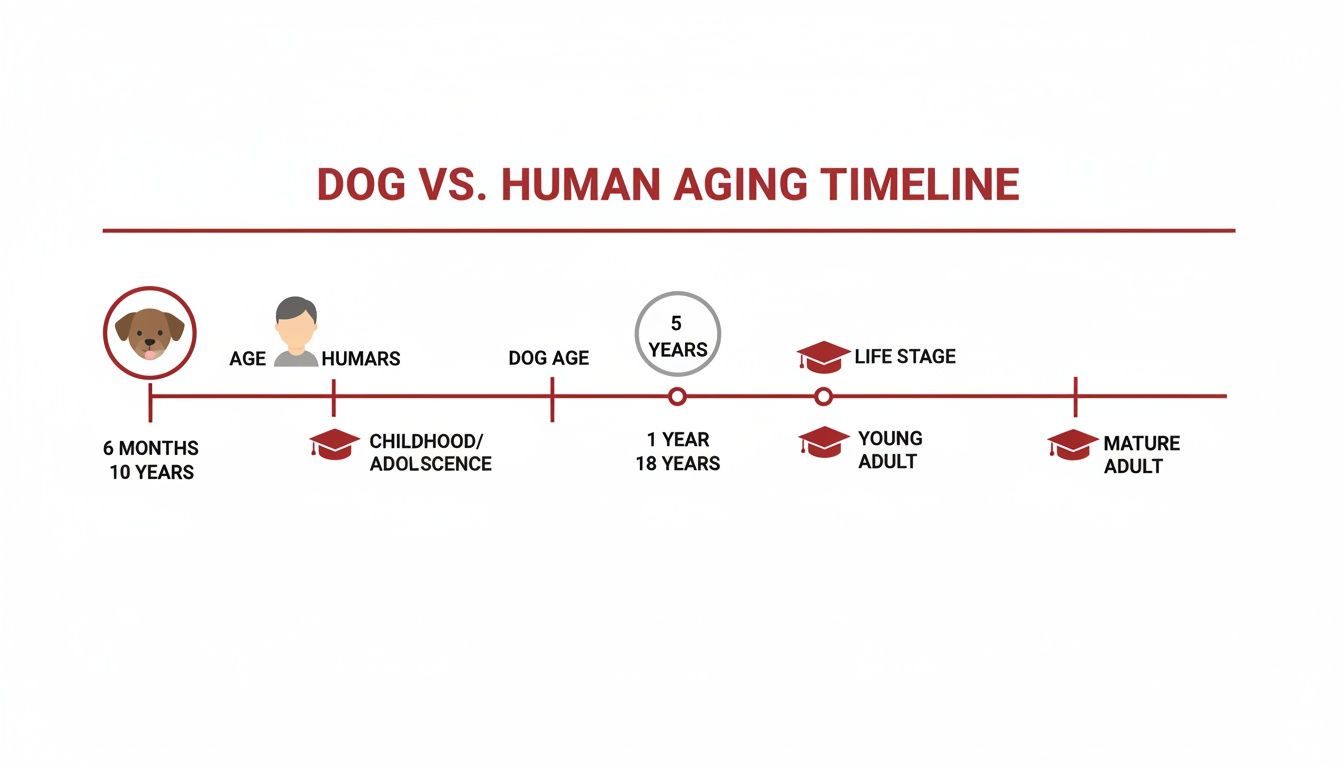
This updated timeline really brings home the massive developmental leap they take in their first two years. After that, the aging process becomes a bit more gradual relative to ours. Grasping this is the first real step toward providing the right kind of care at every stage of their life.
The Biological Clock Ticking Inside Your Dog
To get to the heart of why our dogs' lives seem to fly by, we need to look under the hood at their biological engine. It really boils down to one powerful force: metabolism.
Think of your dog’s metabolism like a car engine that's always running at a much higher RPM than yours. While our human engine is built to idle along efficiently, your dog’s is revving high, burning through fuel at an incredible rate.
This supercharged metabolic rate is what powers their energetic sprints and boundless enthusiasm. It means their heart beats faster, they breathe more rapidly, and their body temperature is naturally a bit higher. But this high-octane lifestyle has a trade-off. All that energy creates faster cell turnover, leading to more rapid wear and tear on their entire system. Just like a car that's always pushed to its limit, a dog's body simply experiences aging on a compressed timeline.
Your Dog’s Genetic Blueprint
Beyond their metabolism, a dog’s very DNA is programmed for a different kind of life. Their genetic blueprint is set up for a shorter, more intense life cycle—one where they grow up fast, reproduce, and hit maturity in a fraction of the time it takes a human.
Think of it like this: Dogs are the sprinters of the animal kingdom, while humans are the marathon runners. A sprinter’s body is built for explosive, short-term power, not long-haul endurance. That’s your dog, genetically wired to live life at full speed.
This isn't a defect; it's a feature shaped by their evolutionary past. Their genes prioritize rapid development in the early years, which was crucial for survival in the wild. Modern science backs this up, with epigenetic research giving us a much more accurate way to map dog age to human years.
The American Veterinary Medical Association points out that the first year of a medium-sized dog's life is roughly equivalent to 15 human years, with the second year adding about another nine. If you're curious, you can find more insights into how dog years really work at Science Focus.
This genetic programming is why your one-year-old pup isn't a toddler but a teenager, and why a seven-year-old dog is already settling into their senior years. This built-in biological clock, working in tandem with their rapid metabolism, is the fundamental reason our dogs' time with us feels so short.
How Your Dog's Size and Breed Affect Their Lifespan
It’s one of the strangest puzzles in the dog world: the smaller the dog, the longer they tend to live. This flips the script on what we see elsewhere in the animal kingdom, where giants like elephants outlive tiny mice by decades. For our canine friends, it's the other way around.
A little Chihuahua might be zipping around well into their teens, often living 15 years or more. Meanwhile, a majestic Great Dane is already considered a senior citizen by age five and might only live for seven to ten years.
This isn't just a random quirk. It’s a well-documented phenomenon that scientists sometimes call the "longevity-size trade-off." It’s a huge clue in figuring out not just why dogs age faster than us, but why a Pomeranian and an Irish Wolfhound are on two totally different timelines. It seems the very thing that makes a big dog big is also what puts their life on fast-forward.
The Hidden Cost of Growing Up Fast
So, what's really going on here? It all comes down to the absolutely breakneck speed at which large-breed puppies grow.
Think about it: a Toy Poodle might gain a handful of pounds in its first year. A Great Dane, on the other hand, can pack on over 100 pounds in that same period. That kind of explosive growth is incredibly demanding and puts a massive strain on their bodies.
Imagine you're building two houses. One is a cozy little cottage you build piece by piece over a year. The other is a huge mansion you have to throw up in that same amount of time. The mansion might look grand, but the rushed job could easily lead to a shaky foundation and problems down the road. It’s a similar story for large dogs, whose rapid cell division can increase the risk for developmental issues and certain cancers later on.
This intense growth phase essentially kicks their aging process into high gear right from the start. Their cells are basically working overtime, causing them to wear out more quickly and shortening their overall lifespan.
The Science Behind Size and a Shorter Life
This isn't just a theory—the numbers back it up. Researchers have found a direct, negative link between a dog's body size and how long they live. In fact, one study found that for every 4.4 pounds of body mass, a dog's life expectancy drops by about one month.
This is why a four-year-old Mastiff is already hitting middle age, roughly the equivalent of a 35-year-old person. If you're curious about the specifics, you can read more about the study on canine longevity here.
The simple truth is that giant breeds live big, but they also live fast. Their accelerated growth spurt sets their internal clock ticking at a much faster rate, pushing them into their senior years while smaller dogs are still in their prime.
Understanding this is so important, no matter what kind of dog you have. It helps you prepare for what’s coming. If you own a large breed, you know you need to be on the lookout for joint issues and other signs of aging much, much sooner. This knowledge empowers you to give them the right support—from their food bowl to their daily walks—for their unique journey through life.
Practical Ways to Support Your Dog's Healthy Aging

Learning why dogs age faster than we do is more than just interesting trivia—it's empowering. Knowing their biological clock is on fast-forward gives us the chance to be proactive and make every year count.
You don't need a complicated plan to support your dog as they grow older. A great wellness strategy really just boils down to a few core pillars that work together to build a foundation for a long, happy life. Let's dig into what they are.
Fueling a Longer Life Through Nutrition
What you put in your dog's bowl is one of the most direct ways to influence their long-term health. A puppy's needs are worlds away from a senior dog's, so their diet has to evolve right along with them.
A balanced diet full of high-quality protein, antioxidants, and Omega-3 fatty acids helps their body fight back against the cellular stress caused by their speedy metabolism. For senior dogs, ingredients like glucosamine can be a game-changer for keeping their joints comfortable.
Key Takeaway: A balanced, age-appropriate diet is non-negotiable. It provides the building blocks their body needs to manage the effects of accelerated aging and maintain everything from joint mobility to cognitive function.
Choosing the right food is about so much more than just preventing hunger; it's about giving their body targeted fuel for whatever life stage they're in. Always check for foods that meet AAFCO guidelines, and have a chat with your vet to find the perfect fit for your dog’s unique needs.
Keeping Their Body and Mind Active
It's no surprise that an active lifestyle is just as important for dogs as it is for us. Regular, moderate exercise is key to maintaining a healthy weight, which takes a huge amount of pressure off their joints—a big deal for any dog, but especially for larger breeds.
Staying active keeps their heart healthy and their muscles strong. But a healthy lifestyle isn't just about the body. Keeping their brain engaged is just as critical for warding off age-related cognitive decline.
Here are a few simple ways to keep their body and brain in top shape:
- Puzzle Toys: These challenge your dog to think and problem-solve for a treat. It’s a fantastic way to light up their mind.
- New Tricks: Who says you can't teach an old dog new tricks? It's a fun way to keep their brain sharp while strengthening your bond.
- Varied Walks: Don't stick to the same old block every day. Letting them explore new smells and sights on different routes is great mental enrichment.
The Power of Proactive Veterinary Care
Because our dogs' lives move so quickly, a seemingly minor health issue can turn into a serious problem before you know it. This is exactly why regular vet check-ups are an absolute must.
Put it in perspective: one annual vet visit for your dog is like a person seeing their doctor only once every 5 to 7 years. A whole lot can happen in that time.
Twice-yearly visits, particularly once your dog becomes a senior, give your vet the chance to catch problems like dental disease, arthritis, or organ issues early on. Being proactive is always better—and often easier—than trying to manage a condition that's already taken hold. This is the cornerstone of any smart plan for a long and healthy life with your dog.
A Daily Routine for Longevity with FORMA

Knowing the "why" behind your dog's rapid aging is a game-changer. It puts you in the driver's seat, allowing you to be proactive about their health instead of just reacting to problems as they pop up. A great routine built on solid nutrition, exercise, and mental enrichment is the foundation, but a targeted supplement can make your efforts even more effective.
Adding a daily superfood chew like FORMA to this routine is a simple way to provide consistent, powerful support. Think of it as a small daily investment in their future, working hand-in-hand with their regular diet to tackle the specific challenges of their accelerated aging.
One Simple Step for Total Wellness
A wellness plan for your dog shouldn’t feel like a chore. The beauty of a single daily chew is that it can deliver specific, high-quality ingredients that support the most vital areas of their health. It's a small action that addresses some pretty complex biological needs.
FORMA was created to be an all-in-one solution, built on four pillars of a healthy life:
- Longevity: Its ingredients are chosen to promote cellular health, helping their bodies cope with the high-octane metabolism that causes so much wear and tear.
- Gut Health: A healthy gut is central to everything. It impacts digestion, nutrient absorption, and even their mood.
- Calmness: We've included natural ingredients to help them manage everyday stress, keeping them more relaxed and content.
- Immunity: A robust immune system is their best defense against illness, which becomes even more important as they get older.
This approach means you're covering the most important bases in one easy step. It’s a simple way to boost the great care you’re already giving them.
Ingredients That Rise to the Challenge of Aging
The real magic behind FORMA is in its formula—it's packed with human-grade, science-backed ingredients. Every single component was picked for a reason, directly tying back to the aging challenges we’ve been talking about. For example, the ingredients that support joint health are a huge plus for large breeds, which grow so fast and often face mobility issues sooner.
By giving your dog this kind of targeted nutritional support, you’re helping their body stand strong against the accelerated aging process. You're giving them the resources they need to stay happy and active for as long as possible.
At the end of the day, FORMA is made to fit right into the life you share with your dog. It gives you a reliable and effective way to elevate their daily wellness, turning what you know about their aging into real, proactive care. That one simple chew becomes a powerful part of their journey to a longer, happier life with you.
Common Questions About Dog Aging
Diving into the science of how our dogs age can definitely spark a few questions. To help put it all together, let's tackle some of the most common things owners ask about their dog’s journey through life.
Is the '1 Dog Year Equals 7 Human Years' Rule Ever Accurate?
Nope, that old rule of thumb is a huge oversimplification. We now know that a dog's aging isn't a straight line. They mature incredibly fast in their first couple of years, and then the pace slows down quite a bit.
For example, a one-year-old pup is biologically more like a 30-year-old human than a seven-year-old kid. This rapid early development, plus the massive differences between breeds, makes any one-size-fits-all formula totally inaccurate.
Do Mixed-Breed Dogs Live Longer Than Purebreds?
Generally speaking, yes. A lot of research backs up the idea that mixed-breed dogs often have longer lifespans than purebreds of a similar size. This is usually chalked up to something called "hybrid vigor."
Hybrid vigor is just a fancy way of saying that a more diverse gene pool makes a dog less likely to inherit the specific genetic problems common to certain breeds, which can sometimes shorten their life.
But this is just a general trend, not a hard-and-fast rule. A well-cared-for purebred from a great breeder can absolutely live a long, happy life. In the end, a healthy lifestyle is the single biggest factor for any dog, mutt or not.
When Is My Dog Officially Considered a Senior?
This one depends almost entirely on their size and breed. Because of the vast differences in how fast dogs age, there’s no single "senior" birthday for every dog. It’s more of a sliding scale.
Here's a quick cheat sheet to give you a general idea:
- Small Breeds (like Chihuahuas and Dachshunds): These little guys age the slowest and usually aren't considered seniors until they're 10-12 years old.
- Medium Breeds (like Beagles and Border Collies): They hit their golden years somewhere around age 8-9.
- Large & Giant Breeds (like Great Danes and Mastiffs): Since they age the fastest, these big dogs are often considered seniors as early as 5-6 years old.
Since this transition varies so much, your veterinarian is your best resource. They can help you figure out the right time to switch to senior-specific food, adjust their exercise, and schedule more frequent wellness checks to keep them feeling their best.

Karolis is the Founder of FORMA, a pet wellness brand focused on longevity and daily nutrition for dogs. Writes about supplements, canine health, and helping pets live longer, healthier lives
Join thousands of pet parents getting science-backed health insights and natural care advice