Calming Supplements for Dogs a Guide to Anxiety Relief
Discover the best calming supplements for dogs. Our guide explains key ingredients, helps you choose the right product, and offers tips for safe anxiety relief.

So, what exactly are calming supplements for dogs? They’re daily chews, oils, or powders made with natural ingredients designed to help your dog feel less stressed and anxious. It's best to think of them as a supportive tool—not a sedative. Their job is to enhance your dog's own ability to handle triggers like thunderstorms, car rides, or being left alone.
These supplements work by giving your dog's nervous system the compounds it needs to stay balanced, helping them feel more grounded and secure.
Understanding Your Dog's Anxiety

It’s heartbreaking to see your best friend struggle with anxiety. The endless pacing during a storm, the whimpering when you pick up your keys, or the shredded pillows are all signs of real distress. It's crucial to remember that these aren't signs of a "bad dog"—they're outward expressions of an internal battle.
Anxiety in dogs is a state of fear or worry that goes beyond just being a little nervous. While it's perfectly normal for a dog to jump at a loud, unexpected noise, persistent anxiety can take a toll on their health, behavior, and overall quality of life. For many of us, it leaves us feeling helpless, searching for a way to bring some peace back into our dog’s world.
Identifying The Signs And Triggers
The first step to helping your dog is learning to recognize when they're anxious. Since they can't use words, we have to become fluent in their body language and behavior.
Some of the most common signs of anxiety include:
- Destructive behavior: Chewing furniture, digging at doorframes, or shredding things around the house, especially when you're gone.
- Excessive vocalization: Constant barking, whining, or howling that isn’t typical for your dog.
- Physical symptoms: Pacing back and forth, trembling, panting (even when it’s not hot), or excessive drooling.
- Avoidance or clinginess: Hiding during scary events or, on the flip side, becoming a "velcro dog" who won't leave your side.
- Potty accidents: When a well-trained dog suddenly starts having accidents in the house, it can be a red flag for severe stress.
These behaviors are almost always tied to specific triggers. Common culprits range from predictable things like fireworks and vet visits to more complex issues like separation anxiety or fear of strangers. Pinpointing what triggers your dog is key to managing their fear effectively.
To help you connect the dots, here’s a quick-reference table that matches common anxiety triggers with the ingredients that can often provide support.
Common Anxiety Triggers and Helpful Calming Ingredients
This table can be a great starting point for finding a supplement that targets your dog’s specific needs.
The Role Of Calming Supplements
This is where calming supplements for dogs can make a real difference. They aren't a magic wand or a substitute for training and a loving environment. Instead, think of them as a way to give your dog's nervous system a helping hand, making it easier for them to cope. They fit perfectly into a holistic wellness routine that supports a happier, more balanced life.
Over the past decade, these supplements have gone from being a niche product to a staple in modern dog care. Why the shift? It’s because we’re all becoming more aware of just how common canine anxiety is. In fact, some surveys show that 60–70% of dogs show at least one sign of anxiety, which has led many owners to seek out daily support. You can read more about this trend in this market analysis from Future Market Insights.
The goal isn't to change your dog's personality or sedate them. It's about providing the nutritional building blocks their body needs to manage stress more effectively, allowing their true, confident self to shine through.
By understanding the root of your dog's anxiety and using tools like calming supplements, you can help pave the way for a more peaceful and secure life for your best friend.
How Do These Calming Ingredients Actually Work?
Ever wondered what’s really going on inside your dog’s head when they take a calming chew? It’s not magic, but it is some pretty fascinating biology.
Picture your dog's nervous system as a seesaw, trying to balance excitement and relaxation. When stress hits—like the rumble of thunder or the sight of you grabbing your keys—the "excitement" side shoots up, leaving your dog anxious and on edge.
Natural calming ingredients don't shove that side down like a heavy sedative would. Instead, they gently add a bit of weight to the "relaxation" side, helping your dog's own body find its balance. This supports their innate ability to cope, helping them feel more grounded without turning them into a zombie.
And this gentle, supportive approach is catching on. Calming chews and supplements are now the most popular format in the entire pet calming market. In fact, they’re projected to make up about 34.7% of global revenue by 2025, easily beating out things like sprays, diffusers, and anxiety wraps. It shows just how much pet owners are embracing ingredients like L-theanine and chamomile for everyday support. You can dig deeper into these trends over at Straits Research.
The Amino Acid All-Stars
Some of the most powerful calming agents aren't weird, exotic herbs. They're simple amino acids—the same building blocks that make up protein. These guys have a direct line to the brain's mood-control center.
L-Tryptophan is a classic example. Your dog’s body converts this amino acid directly into serotonin, which you’ve probably heard called the "feel-good" chemical.
- Here's an analogy: Think of L-Tryptophan as the flour you need to bake a loaf of happy bread (serotonin). If you don't have enough flour, you simply can't bake the bread.
- The result? By giving your dog a steady supply, you’re ensuring their brain has what it needs to maintain a stable, positive mood, making them less likely to fly off the handle at every little stressor.
L-Theanine, an amino acid naturally found in green tea, takes a slightly different route. It boosts alpha brainwaves, which are linked to a state of "wakeful relaxation."
- Think of it like this: L-Theanine is like putting a pair of noise-canceling headphones on your dog's brain. It doesn’t knock them out; it just quiets the overwhelming mental static.
- The result? This creates a sense of calm focus, which is perfect for training sessions or just helping a dog settle down without making them drowsy.
These amino acids are the foundation of many top-tier calming supplements for dogs because they work with your dog’s body, not against it.
Powerhouse Botanicals From Nature's Toolkit
For centuries, people have turned to plants to find a sense of calm, and the same botanicals can work wonders for our dogs. These herbs contain natural compounds that gently interact with the nervous system to soothe and settle.
Chamomile is probably the most famous calming herb out there. It contains a compound called apigenin that binds to certain receptors in the brain, helping to dial down anxiety and promote a bit of sleepiness. It’s gentle, making it great for daily use or helping a restless pup unwind at night.
Valerian Root is a bit more potent and is known for its mild sedative qualities. It works by increasing a neurotransmitter called GABA (gamma-aminobutyric acid) in the brain.
GABA is essentially the brain's brake pedal. When GABA levels are low, the brain's engine can rev way too high, leading to anxiety and restlessness. Valerian helps make sure those brakes are working properly.
Finally, there’s Passionflower, another botanical that gives GABA a boost. It’s fantastic for situational anxiety because it helps quiet a racing mind, making it easier for a dog to handle triggers like car rides or vet visits.
How These Ingredients Work Better Together
The real magic happens when these ingredients are combined in a smart, synergistic formula. A top-notch supplement won’t just throw one ingredient at the problem; it creates a multi-pronged strategy for calming your dog.
For instance, a great formula might use:
- L-Tryptophan to build a solid foundation of serotonin for long-term mood stability.
- L-Theanine to provide that clear-headed calm needed during a stressful event or training.
- Chamomile to gently encourage relaxation at the end of a stimulating day.
This kind of combination tackles anxiety from all sides. It helps manage the immediate stress while also building up your dog’s emotional resilience over time. When you understand how these key players work, you can read a supplement label with confidence and pick a product that offers a thoughtful, science-backed solution for your best friend.
How to Choose the Right Calming Supplement
Walking down the pet aisle or scrolling online, it's easy to feel overwhelmed by all the calming supplements out there. But picking the right one doesn't have to be complicated. The trick is to stop thinking about finding a supplement and start thinking about finding the one that perfectly fits your dog's unique personality and specific anxieties.
It's a bit like being a detective. You need to gather the clues before you can solve the case. Getting this right from the start means you’re giving your dog safe, effective support that actually makes a difference.
This guide will give you a simple framework to follow, so you can feel confident you're making the best choice for your best friend.
Start by Defining Your Dog's Needs
Before you even think about brands or ingredients, take a step back and just observe your dog. What does their anxiety actually look like? Getting clear on this is the single most important step.
Ask yourself a few key questions to zero in on the problem:
- Is the anxiety situational or constant? Does it only pop up during thunderstorms, or is your dog always a little on edge?
- What are the primary triggers? Get specific. Is it being left alone, the sound of the vacuum, car rides, or new people coming over?
- What is the desired outcome? Are you hoping for something to gently take the edge off? Or do you need to promote calm focus for training without making them sleepy?
Different problems require different solutions. This decision tree can help you connect your dog's specific needs to the right kind of ingredients.
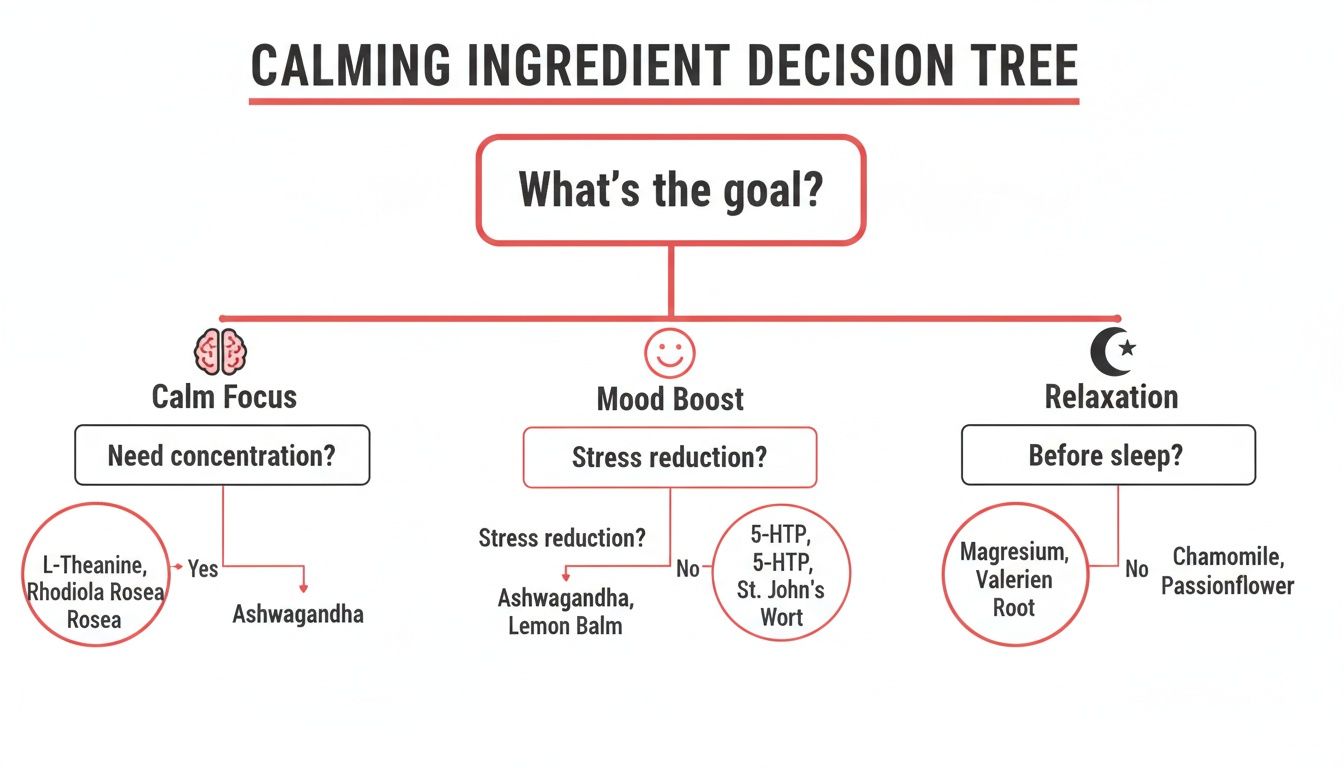
The big takeaway here is that you can tailor your approach. You're not just grabbing a generic "calming" product; you're choosing specific ingredients for a specific goal.
Scrutinize the Ingredient List and Quality
Okay, now that you know what you're trying to solve, it's time to put on your label-reading glasses. Let’s be honest: not all calming supplements for dogs are created equal. The quality of what's inside the package makes all the difference between a product that works and one that’s just a waste of money.
Look for formulas that use the science-backed ingredients we talked about earlier, like L-theanine, chamomile, and L-tryptophan. Transparency is also huge. Good companies are proud to tell you where their ingredients come from and how they make their products.
Pro Tip: One of the easiest ways to spot a quality product is to look for the words "human-grade ingredients." This simple phrase means the ingredients meet the same high safety and quality standards as food for people.
Another non-negotiable is third-party testing. This means an independent lab has verified that the product actually contains what the label says it does and is free from nasty contaminants. It’s an essential layer of quality control that gives you peace of mind.
Choose the Best Format for Your Dog
The most powerful supplement in the world is useless if you can't get your dog to take it. Luckily, calming aids come in a few different forms, so you can find one that fits seamlessly into your routine.
It's all about finding what works for you and your pup. Some owners love the precision of oils, while others prefer the grab-and-go ease of a chew.
Here's a quick comparison to help you decide.
Comparing Supplement Formats: Chews vs. Oils vs. Powders
Ultimately, the right choice boils down to your dog’s preferences. If your mornings are hectic, a pre-portioned chew from a brand like FORMA is a no-brainer. The key is to pick a format you can stick with consistently.
Weaving Supplements Into Your Dog's Daily Life

So, you’ve picked out a great calming supplement. That's the first step. Now, let’s talk about how to make it a seamless—and successful—part of your dog’s routine. The real magic isn't just in the supplement itself, but in how you introduce and use it to support your dog's overall well-being.
Think about it like starting a new food. The golden rule is to start slow. Even with the best natural ingredients, every dog's system is a little different.
I always recommend beginning with half the suggested dose for the first few days. This gives your dog's body a chance to get used to the new ingredients and significantly cuts down on the risk of an upset stomach. Keep an eye on your pup, and if all is well, you can ease them into the full dose.
Consistency is Everything
One of the biggest pitfalls I see is owners using calming supplements only when their dog is already stressed. While some formulas can offer quick relief, many of the most effective ingredients work their magic over time. They build up in your dog’s system, creating a more balanced and resilient state of mind.
For a dog struggling with ongoing anxiety, a consistent daily dose is the key. Giving the supplement at roughly the same time each day maintains a steady level of support, building a solid foundation for your dog to stand on.
This is what turns a supplement from a quick fix into a genuine wellness tool. You wouldn't go to the gym once and expect to be fit, right? The same logic applies here. Patience and a predictable routine are your most powerful allies.
Smart Timing for Stressful Moments
While a daily dose builds that crucial baseline of calm, you can also use supplements strategically for those predictable stressors. This is your chance to get ahead of the anxiety before it even starts.
Here’s a simple game plan for those moments:
- Look Ahead: Know a thunderstorm is coming? Got a vet visit on the calendar? Plan for it.
- Give a Head Start: Administer the supplement about 30 to 60 minutes before the event kicks off. This gives the active ingredients time to get to work.
- Make It a Good Thing: Pair the supplement with something your dog loves, like a bit of peanut butter or a high-value treat. You want them to associate it with a positive experience.
For example, if you know fireworks are scheduled for the evening, giving a calming chew an hour beforehand can prime your dog’s nervous system to better cope with the noise. It’s far more effective than trying to soothe a dog who's already in a full-blown panic.
A Supplement is a Tool, Not a Cure-All
Finally, it’s vital to remember that calming supplements for dogs are just one piece of the puzzle. They work best when they're part of a bigger picture.
Lasting calm is a team effort. Make sure your dog gets plenty of exercise to burn off anxious energy and enough mental stimulation (like puzzle toys or training games) to keep their brain busy. A predictable schedule for meals, walks, and rest also works wonders, giving your dog a sense of security and structure.
When you combine a quality supplement with positive training, a stable routine, and a loving home, you create a powerful synergy. This holistic approach doesn't just put a bandage on anxiety—it helps you build a happier, more confident, and well-adjusted best friend.
Of course. Here is the rewritten section with a more natural, human-written tone.
More Than Just a Calming Treat: The Bigger Picture
Most of us reach for a calming supplement with one thing in mind—getting through the next thunderstorm or car ride without a meltdown. But the best formulas do so much more than just take the edge off. They tap into your dog's overall well-being, building a powerful connection between a settled mind and a healthy body.
When you start to see it this way, a calming supplement isn't just a quick fix. It becomes a cornerstone of your dog's daily health routine, making it easier to know you're giving them what they need to truly thrive, not just get by.
The Gut-Brain Connection is a Two-Way Street
You’ve probably heard about the gut-brain axis in people, and it’s just as important for our dogs. Imagine a direct hotline running between your dog’s stomach and their brain. What happens in the gut doesn’t stay in the gut—it sends messages straight to the head, influencing everything from mood to stress responses.
When your dog's gut is full of good bacteria, it sends "all clear" signals to the brain. But if that balance gets thrown off by stress, a poor diet, or even an illness, the gut starts sending out distress signals. Those signals can show up as anxiety, fear, and edginess.
This is exactly why you're seeing more and more calming supplements for dogs with probiotics mixed in. These good bacteria get to work rebalancing the gut environment.
- A Healthier Gut: Probiotics help keep the gut lining strong and digestion running smoothly.
- A Better Mood: A happy gut actually helps produce neurotransmitters like serotonin—the "feel-good" chemical that keeps moods stable.
- A Calmer Response: By getting the gut in order, the body's main stress hormone, cortisol, doesn't spike as easily.
By focusing on gut health, these supplements calm your dog from the inside out. It's a much smarter approach than just trying to quiet the symptoms.
How a Calm Dog Has a Stronger Immune System
A dog who is always on edge is also a dog whose body is swimming in cortisol. Over time, this constant low-level stress wears down their immune system, making them more likely to get sick or suffer from chronic inflammation. It's exhausting for their body.
A stable emotional state is the bedrock of a strong immune system. When you help reduce your dog’s chronic stress with a daily calming supplement, you’re protecting their body from that constant wear and tear. That can add up to a longer, healthier life.
This forward-thinking approach is becoming the new normal, especially for owners who see their dogs as part of the family. Millennial pet parents, in particular, are looking for supplements that do it all—calming, longevity, immunity, and gut health in one. This trend, which mirrors what’s happening in human wellness, is a huge driver of growth in the pet care world. You can read more about the booming pet dietary supplements market at Precedence Research.
Think Proactive, Not Reactive
At the end of the day, choosing a multi-benefit calming supplement is about making a simple shift: from fixing problems to preventing them. Instead of waiting for anxiety to spike, you’re giving your dog the daily support they need to stay balanced and resilient.
This approach just makes sense.
- It gets to the root of the problem, tackling things like gut imbalances that fuel anxiety.
- It supports the whole body, because a less-stressed nervous system means a stronger immune system.
- It builds resilience over time, helping your dog handle whatever life throws at them a little bit better.
Adding a great supplement to your dog's daily routine isn't just about managing anxiety. It's about laying a foundation for a lifetime of wellness. It’s one of the easiest and most meaningful investments you can make in their health and happiness.
Common Questions About Calming Supplements for Dogs
When you start looking into calming supplements for dogs, it’s only natural for questions to pop up. As a pet owner, you want to feel completely confident before you add anything new to your dog’s diet. Let's walk through some of the most common things people ask.
Think of this as a straightforward conversation to clear up any confusion. We've compiled the top questions we hear from dog owners and provided simple, direct answers to help you make the best choice for your furry friend.
How Long Do Calming Supplements Take to Work?
This is usually the first question on everyone's mind! The honest answer is: it depends. The timing really comes down to the ingredients in the supplement and what kind of anxiety your dog is dealing with. Some formulas are designed to work quickly, while others focus on building long-term emotional balance.
It helps to think of it in two ways: fast-acting relief versus foundational support.
For sudden, stressful events—like an oncoming thunderstorm or a dreaded car ride—ingredients like chamomile and L-theanine can kick in relatively quickly, often showing a noticeable calming effect within 30 to 90 minutes.
On the other hand, ingredients like L-tryptophan work more like a vitamin. They build up in your dog’s system over time to create a more stable mood. For these, you'll want to give them daily for at least two to four weeks before you see a real difference in their baseline anxiety.
The key is to be patient and consistent. Think of fast-acting formulas as your go-to tool for predictable events, while daily supplements are essential for building a more resilient, less anxious dog over the long haul.
Are There Any Side Effects of Calming Supplements?
Safety is always the number one priority, and rightfully so. The good news is that high-quality, natural calming supplements are generally very safe and carry a low risk of side effects, especially when you compare them to prescription medications.
When side effects do show up, they’re usually very mild and don't last long. The most common things you might notice are:
- Slight drowsiness: This can happen with ingredients like valerian root, especially if the dose is a little high for your dog's size.
- Mild stomach upset: A new supplement can sometimes cause a little bit of gas or a slightly looser stool as your dog's system adjusts.
The best way to avoid any issues is to start slow. Begin with the recommended dose, or even just half of it, for the first few days to see how your dog handles it. Choosing products from trusted brands like FORMA, which use transparent, human-grade ingredients, adds another layer of peace of mind.
Can I Give My Dog Calming Supplements Every Day?
Yes, you absolutely can! In fact, for many dogs, that’s the best way to use them. Most of the best calming supplements for dogs are specifically made for safe, daily, long-term use.
Think of it like taking a daily vitamin. Giving the supplement consistently helps your dog maintain a steady, balanced mood by continuously supporting their nervous system. This approach avoids the emotional ups and downs that can happen when you only use a supplement during a stressful moment.
Formulas that do more than just calm—like those with added probiotics for gut health or antioxidants for immunity—are perfect for a daily routine. They become a proactive part of keeping your dog healthy and happy. Just make sure you stick to the dosage instructions on the label.
How Are Supplements Different from Prescription Sedatives?
This is a really important distinction. While both are used to help anxious dogs, they work in completely different ways. It’s like comparing a cup of calming herbal tea to a powerful sleeping pill.
Natural Calming Supplements
- How they work: They use natural ingredients like L-theanine or chamomile to gently encourage the body’s own calming mechanisms. The goal is relaxation, not heavy sedation.
- Who they're for: These are perfect for managing mild to moderate stress, like fear of loud noises, separation anxiety, or general restlessness. They are a wellness tool for everyday life.
Prescription Sedatives
- How they work: These are strong, vet-prescribed drugs that act directly on the central nervous system to cause significant drowsiness and reduce a dog’s awareness of their surroundings.
- Who they're for: Vets reserve these for severe anxiety, true panic disorders, or for procedures where sedation is required. They aren’t meant for managing day-to-day stress.
In the end, supplements are designed to help your dog feel more secure and balanced. Prescription medications are a clinical intervention for serious cases that require a much stronger, more direct approach from a veterinarian.

Karolis is the Founder of FORMA, a pet wellness brand focused on longevity and daily nutrition for dogs. Writes about supplements, canine health, and helping pets live longer, healthier lives
Join thousands of pet parents getting science-backed health insights and natural care advice