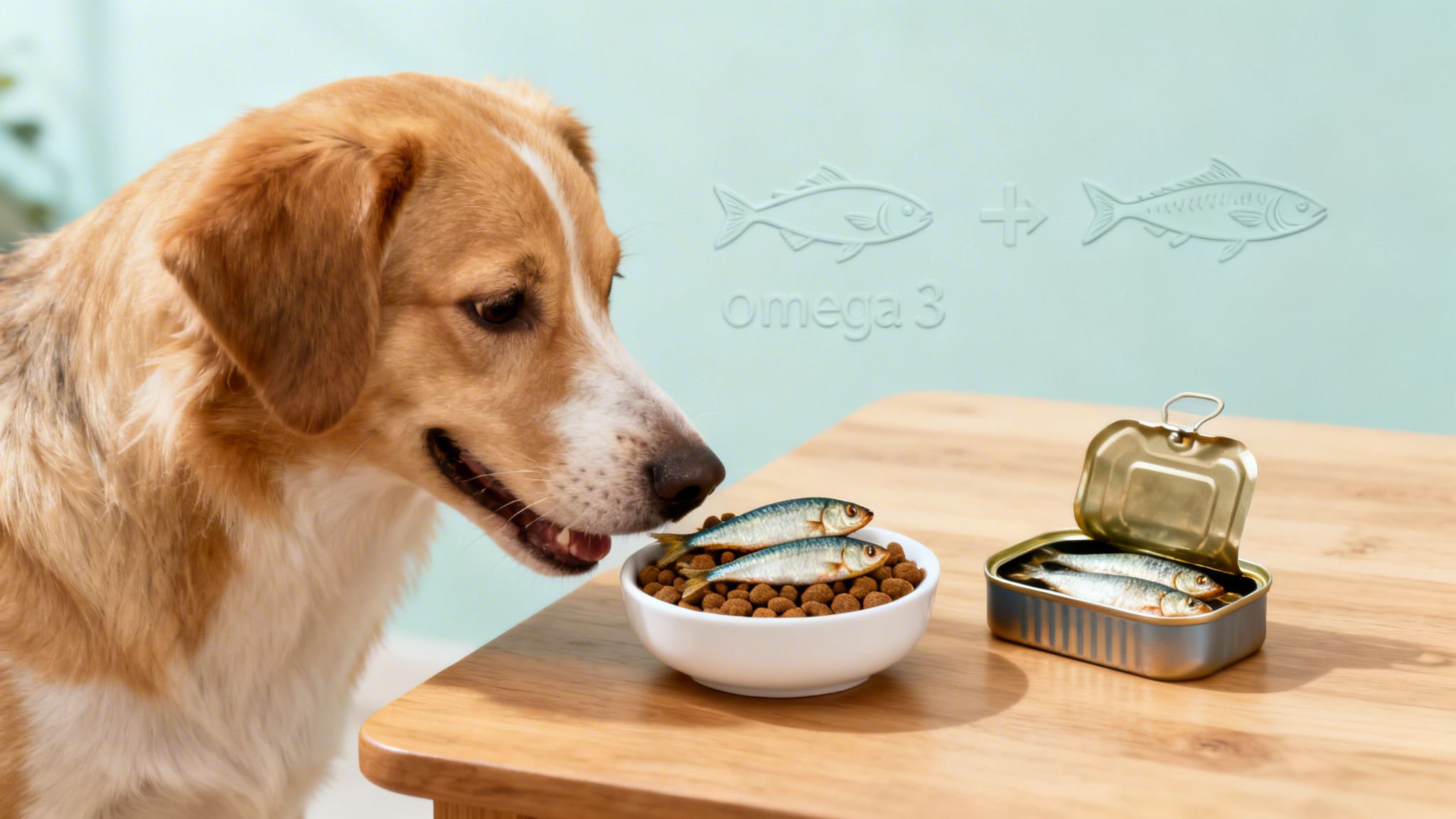
Collagen for Dogs Joints A Guide to Better Mobility
Discover how collagen for dogs joints can help rebuild cartilage, ease arthritis pain, and improve mobility. Find the best supplements and proper dosage.

Let's get right to it. Think of collagen as the super-glue that literally holds your dog's body together. It's the primary protein that makes up their connective tissues—everything from skin and tendons to, most importantly, the cartilage in their joints.
This cartilage is the smooth, rubbery cushion that prevents bones from grinding against each other. It’s the reason your dog can leap for a frisbee or bound up the stairs without a hint of pain. Collagen is the magic ingredient that keeps that cushion strong and springy.
How Collagen Supports Your Dog’s Joint Health
Just like us, as dogs get older, their bodies slow down their natural collagen production. This isn't just a minor change; it's a major reason why so many senior dogs start to look stiff and feel sore.
When collagen levels drop, that essential cartilage cushion starts to thin out and weaken. The result? Bones get closer, friction increases, and you start seeing the classic signs of joint discomfort and inflammation. It's a natural process, but it definitely impacts their mobility and happiness.
A great way to think about it is to picture the shock absorbers in a car. When the car is brand new, those shocks are thick and bouncy, making for a smooth ride. Collagen is the key material that gives those shocks their strength. But after years on the road, the material wears down, and suddenly every little bump feels like a major jolt.
Giving your dog a collagen supplement is like sending their joints to a first-class repair shop. You're supplying the exact amino acids—the fundamental building blocks—their body needs to patch up and maintain healthy cartilage. This isn't just about masking pain; it’s about supporting the body's own ability to rebuild.
What Collagen Does for Your Dog
When you replenish your dog's collagen supply, you're directly helping their joint structure and function in a few powerful ways.
Here's a quick look at how collagen supplementation can make a real difference for your dog's joints, helping them stay comfortable and active.
This powerful combination of benefits is why collagen has become a go-to for so many dog owners and vets looking to be proactive about joint health.
Whether you have a senior dog, a breed known for joint problems, or just want to get ahead of the game, collagen offers a foundational approach to long-term joint care.
At the end of the day, a high-quality collagen supplement is one of the simplest and most effective ways to help your dog feel their best. You're tackling the root cause of age-related stiffness by giving their body the exact tools it needs to keep its natural shock absorbers in top condition for years to come.
The Science Behind How Collagen Rebuilds Joints
To really get how collagen for dogs joints works, we need to look at what it actually is. Think of collagen as the "glue" holding your dog's body together. It's the most common protein they have, forming the main framework for all their connective tissues—like cartilage, tendons, and ligaments. It's basically the body's internal scaffolding.
But it’s not just one thing. There are different types of collagen, each with a specific job.
When it comes to joint health, Type II collagen is the real star of the show. Imagine it as a strong, flexible mesh that gives cartilage its springiness and shock-absorbing power. This mesh is what cushions the ends of your dog's bones, letting them run, jump, and play without pain.
Every time your dog moves, that cartilage acts like a little sponge, compressing and decompressing to protect the joint. The problem is, as dogs get older or just from years of happy, active living, their natural collagen production starts to slow down. That sturdy mesh begins to wear thin, and the joint's cushion gets less effective.
How Collagen Peptides Get to Work
This is where a good supplement can make a world of difference. But you can't just give a dog any old collagen. The secret lies in using hydrolyzed collagen. This just means the collagen has been broken down into tiny, easy-to-digest pieces called peptides. These little guys are small enough to pass through the gut and into the bloodstream.
Once they're in, these collagen peptides do two really important things.
First, they deliver the raw materials—essential amino acids like glycine and proline—that your dog’s body needs to build its own new collagen. It's like dropping off a fresh supply of top-quality building materials right where the repair crew is working.
Second, and this is the really clever part, these peptides act as signals. They travel to the joints and basically nudge the specialized cartilage cells (called chondrocytes) to get busy making more collagen. It’s a bit like a foreman showing up on a job site and telling the crew to ramp up production.
By providing both the building blocks and the instructions, hydrolyzed collagen doesn't just patch up damaged cartilage—it stimulates the body to actively rebuild and fortify it from within.
This process helps make the cartilage cushion thicker and bouncier again, strengthening the entire joint.
This visual shows the whole cycle perfectly—from a healthy joint to one that's starting to show wear and tear, and how the right support can help.
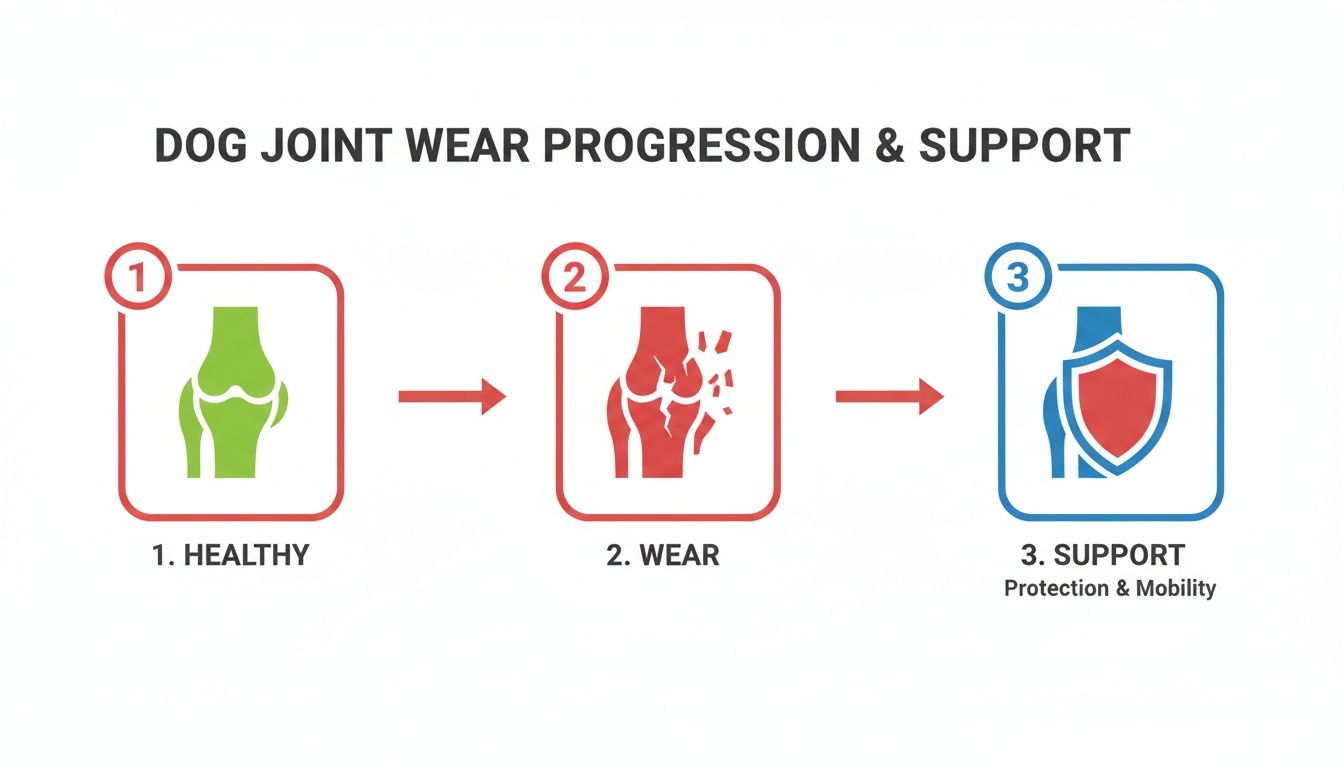
You can see how a joint can degrade over time, but also how targeted support helps protect its structure and keep your dog moving comfortably.
It's More Than Just a Quick Fix
It’s so important to understand that this isn’t just about masking symptoms. Pain medication might make a dog feel better for a few hours, but collagen gets to the root of the problem by working at a cellular level. By helping rebuild the cartilage, it improves how the joint actually functions for the long haul.
Here's a simple breakdown of what happens when your dog takes a collagen supplement:
- Ingestion: Your dog eats the supplement, and the hydrolyzed collagen is broken down into tiny peptides in their stomach.
- Absorption: Because they're so small, these peptides are easily absorbed into the bloodstream. Many other proteins are too big for this to happen effectively.
- Travel & Signal: The peptides circulate through the body and gather in the cartilage and other joint tissues.
- Stimulation: They signal the cartilage-building cells to start producing more Type II collagen and other essential components that make up a healthy joint.
- Rebuilding: Over time, this new production helps repair worn-down cartilage, improves joint lubrication, and can even reduce the inflammation that comes from bones rubbing together.
This isn't an overnight miracle, of course. Rebuilding tissue takes time and consistency. But by supporting your dog's own natural healing processes, using collagen for dogs joints provides a foundational strategy for managing their comfort and keeping them active for years to come.
Subtle Signs Your Dog May Need Joint Support

Joint discomfort in dogs rarely announces itself with a sudden yelp or a dramatic limp. It usually creeps in quietly, showing up as small changes in their behavior that are all too easy to dismiss as just "getting older" or having an off day.
But catching these early clues is everything. The sooner you spot the signs of joint stiffness, the quicker you can provide support like collagen for dogs joints. This helps them stay comfortable and active for many more years.
Most of us only recognize there's a problem when it's obvious and severe. Your dog, however, has probably been sending you subtle signals for a while. If you know what to look for, their daily habits can tell you a lot about how their joints are feeling.
Changes in Movement and Activity
Often, the clearest signs are in how your dog moves—or, more telling, how they avoid moving. Actions that used to be easy might now take a little more effort and planning on their part.
Do any of these moments sound familiar?
- Hesitation Before Action: Does your dog pause and seem to size up the couch before jumping on? That little bit of hesitation can be a sign they’re bracing for an uncomfortable landing.
- Slower to Rise: One of the most common early signs is stiffness after lying down. If they take a few moments to "walk it off" after a nap before moving normally, their joints are probably feeling the strain.
- Struggling with Stairs: Avoiding the stairs, taking them one step at a time, or moving much more slowly up and down is a classic sign of joint pain.
These small adjustments are your dog’s way of telling you that their joints could use some help.
Think of it like this: If your own knees were sore, you'd probably think twice before running up a flight of stairs or hopping over a puddle. Your dog is doing the same thing—adjusting their movements to minimize pain.
Behavioral and Mood Shifts
Achy joints don't just affect a dog's body; they can also change their mood and how they interact with you. A dog living with chronic discomfort might act very differently, which can be confusing if you don't connect it to a physical cause.
Keep an eye out for these behavioral clues:
- Increased Irritability: A dog who was once easygoing might get grumpy or even snap when you touch them, especially near their hips or legs. It's not a personality change—it's a reaction to pain.
- Obsessive Licking or Chewing: Dogs often try to soothe sore spots by licking them over and over. If you notice your dog is fixated on a specific joint, that's a huge red flag that something hurts.
- Lagging on Walks: Is your furry friend, who used to pull you down the street, now trailing behind? A slower pace or wanting to head home early can mean that walking is becoming painful.
These behavioral shifts are more common than you might think. Canine arthritis is incredibly widespread, fueling a huge demand for supportive treatments. The global companion animal arthritis market was valued at USD 3.4 billion in 2023, with osteoarthritis being the main driver. Therapies that include collagen for dogs joints are a popular choice for managing the condition due to their regenerative properties. You can discover more insights about the companion animal arthritis market to see just how common this is.
By learning to read these quiet signals, you can shift from reacting to a problem to proactively managing your dog's health. Catching joint issues early lets you put simple, effective support in place, ensuring your best friend lives a happier, more comfortable life.
How to Choose a High-Quality Collagen Supplement
Walking down the pet supplement aisle can feel overwhelming. Dozens of bottles, all promising the world for your dog's joints. When you're looking for the right collagen for dogs joints, it's easy to get lost in the marketing hype.
But here’s the thing: a top-notch supplement can be a game-changer, while a poorly made one is just a waste of money. The key is knowing what to look for on the label. It’s not about flashy branding; it’s about the source of the collagen, how it’s processed, and what else is—or isn't—inside.
The demand for these products is exploding for a reason. The dog joint supplement market is expected to hit USD 1.1 billion globally in 2025 and grow to a staggering USD 2.0 billion by 2035. This growth is fueled by loving owners who want to give their dogs the best, especially since research shows up to 40% of adult dogs could use some joint support. You can read the full research about the joint supplement market to see the trends for yourself.
Look for Hydrolyzed Collagen Peptides
If you remember only one thing from this guide, make it this: look for the word hydrolyzed. This isn’t just marketing jargon; it's a non-negotiable feature for any collagen supplement worth your money.
So, what does it actually mean? In its natural state, a collagen molecule is a long, complex chain. Think of it like a tangled ball of yarn. Hydrolyzing is a process that uses water to gently break that big molecule down into tiny, manageable pieces called peptides.
These smaller peptides are incredibly easy for your dog’s body to absorb and shuttle directly to where they're needed—the cartilage, bones, and connective tissues. Without this step, the big, clunky collagen molecules would just pass right through their digestive system, offering very little benefit.
Key Takeaway: Always pick a supplement that clearly states it contains hydrolyzed collagen peptides. This is your guarantee of maximum bioavailability, meaning your dog’s body can actually absorb and use what you’re giving them.
Check the Source and Type
Where the collagen comes from is just as important as how it's processed. Different sources provide different types of collagen, so you want to choose one that best supports your dog's joints.
Here are the best sources to look for:
Bovine Collagen: Sourced from cows, this is a fantastic all-rounder, rich in Type I and Type III collagen. The best products will specify "grass-fed" or "pasture-raised," which points to a higher quality of life for the animal and a cleaner, more ethical product.
Marine Collagen: Sourced from fish, this form is almost pure Type I collagen and is famous for being absorbed very efficiently. It’s a great choice, especially for dogs who might have sensitivities or allergies to beef.
For joint health in particular, Type II collagen is the superstar because it’s the main type found in cartilage. Many high-end bovine collagen supplements will naturally contain a mix of all three types, giving your dog well-rounded support.
Read the Ingredient List Carefully
The ingredient list tells the true story of a supplement. You're looking for a clean, simple, and transparent label—all substance, no fluff.
Here are the red flags to watch out for:
Fillers: Avoid products padded with corn, wheat, soy, or other cheap fillers. They add zero nutritional value and can be common allergens for dogs.
Artificial Additives: There's no need for artificial colors, flavors, or preservatives. A quality product doesn't need to hide behind fake bacon flavoring.
Sugars and Sweeteners: This is a big one. Never give your dog a supplement that contains added sugars or sweeteners like corn syrup. They are actively harmful to your dog's overall health.
A great collagen supplement will have a short, easy-to-understand ingredient list, with collagen peptides front and center. It might also include other joint-friendly compounds like glucosamine or chondroitin, which can create a powerful synergistic effect.
Comparing High-Quality vs. Low-Quality Collagen Supplements
To make it even simpler, here's a quick comparison table to help you spot the good from the bad when you're shopping.
Keeping this checklist in mind will help you cut through the noise and confidently choose a potent and pure collagen for dogs joints. Your best friend deserves nothing less.
Administering Collagen Safely and Effectively
Giving your dog a new supplement shouldn't be a big production. When you start giving collagen for dogs joints, the two most important things are consistency and getting the dose right. Just like with most supplements, the proper amount is almost always tied to your dog's weight.
While products vary, there's a simple logic to it: little dogs need less, and big dogs need a bit more to get the same great results.
But here’s the most important rule: always follow the manufacturer's specific instructions right on the label. They've done the work to figure out the ideal amount for their specific formula. If you're ever unsure, a quick call to your vet is the best way to get personalized advice and feel confident you're on the right track.
Making It a Treat, Not a Task
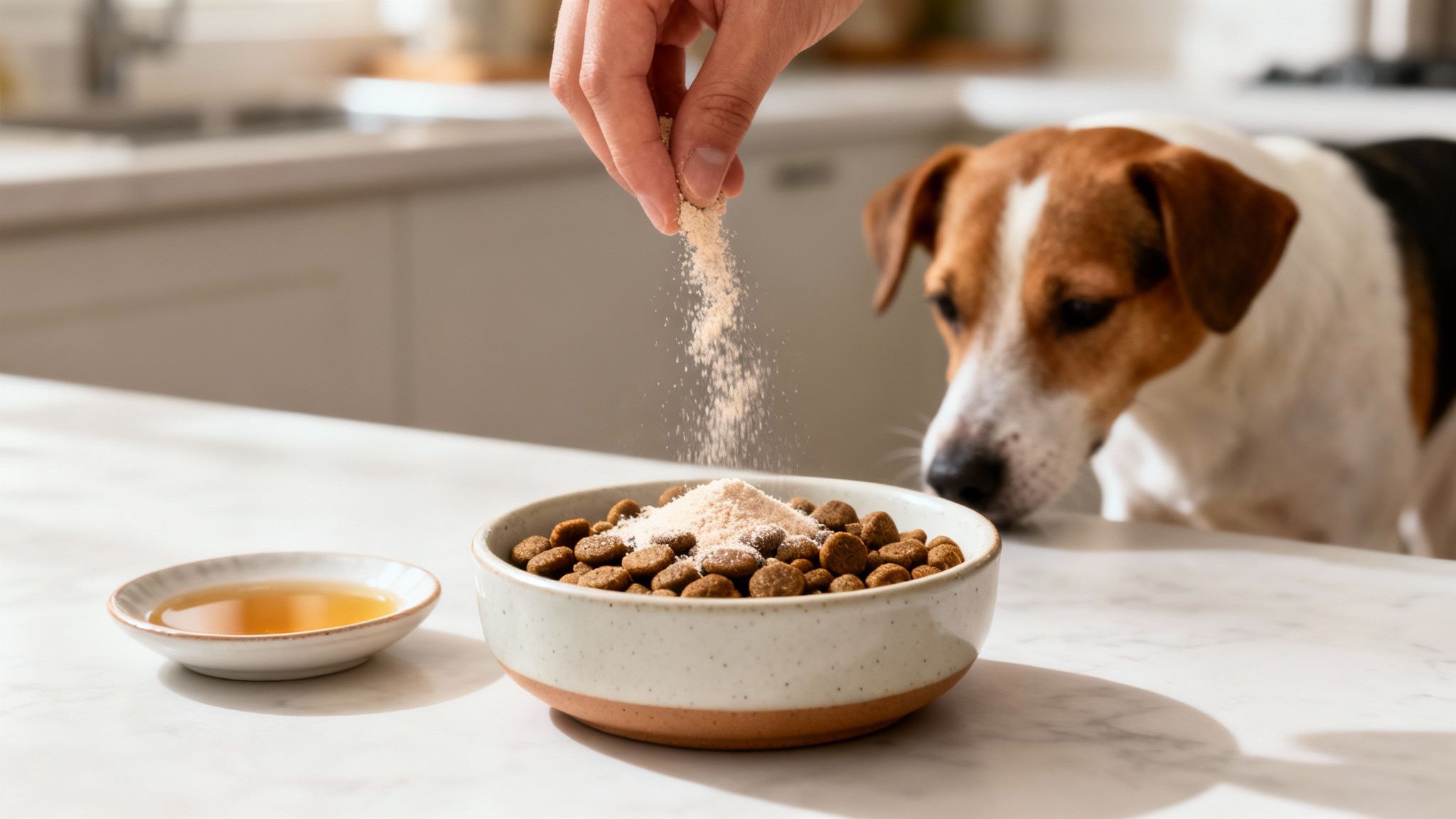
Let's be honest, the best supplement is one your dog actually takes without a fuss. Luckily, most high-quality collagen powders are designed to be tasteless and dissolve easily, so you can slip it into their food without them being any the wiser.
Here are a few easy ways to make it part of their mealtime:
- Make a "Collagen Gravy": Just mix the powder with a little warm water and pour it right over their kibble. It adds a bit of flavor and moisture, and they'll lick the bowl clean.
- Mix into a Tasty Topper: A spoonful of plain yogurt, pumpkin purée, or bone broth makes a perfect vehicle for collagen. It turns supplement time into a special treat they'll start looking forward to.
- Stir into Wet Food: If your dog is on a wet or fresh food diet, it couldn't be easier. Just stir the powder directly into their meal—it’ll blend right in.
Adding a scoop of collagen to a dog's bowl is more common than you might think. In 2022, the global market for pet hip and joint supplements hit a staggering USD 1.18 billion. And get this—the dog segment made up over 41% of that market. It just goes to show how many of us are turning to ingredients like collagen to keep our dogs feeling their best. You can see the data on the growing pet joint supplement market for yourself.
Be Patient and Consistent
It's really important to have the right expectations from the start. Collagen isn't a quick fix or a painkiller; it works by giving the body the raw materials it needs to repair itself. That process takes time.
Think of it like watering a plant. You don't see new leaves the next day, but with steady, daily care, you'll eventually see it thrive. The same principle applies here.
Most dog owners start to see real, noticeable improvements in their dog’s comfort and mobility within about four to six weeks of daily use. So, stick with it! The payoff for your patience is seeing your dog get that spring back in their step.
A Holistic Approach: Where Collagen Fits in Your Dog's Wellness Routine
Adding a high-quality collagen supplement is a brilliant move for your dog's joint health, but it's even more powerful when it's part of a bigger picture. Think of it like this: collagen is a star player, but even the best player needs a solid team to win the championship. For your dog, that "team" is a complete wellness plan that supports their mobility, energy, and happiness for the long haul.
Great joint care is never about just one thing. When you incorporate collagen for dogs joints into a broader strategy, you're creating an environment where their body can truly thrive. This means taking a look at their diet, exercise, and overall health to build a rock-solid foundation for an active life.
The Foundation: Managing Your Dog's Weight
If there’s one thing you can do for your dog's joints that will make a massive impact, it's keeping them at a healthy weight. Every extra pound puts a huge amount of unnecessary strain on their cartilage and ligaments, speeding up wear and tear. It’s like forcing a small car to constantly haul a heavy trailer—sooner or later, the suspension is going to give out.
When a dog is overweight, the pressure on their hips, knees, and spine skyrockets. This not only makes existing joint pain worse but can actually cause problems in otherwise healthy joints. Keeping your dog lean isn't just a good idea; it's a non-negotiable part of any serious joint care plan.
A healthy weight is the ultimate preventative medicine. By lightening the daily load on their joints, you are directly preserving their cartilage and giving them more years of comfortable, happy movement.
The best place to start is with a balanced, species-appropriate diet. Your vet can help you figure out the right amount of calories and nutrients your dog needs to stay trim without feeling deprived. This simple adjustment can make all the difference.
Smart Exercise for Strong and Supple Joints
Movement is medicine for joints. It keeps them lubricated and strengthens the muscles that support them. But it’s crucial to choose the right kind of exercise. High-impact activities, like launching into the air to catch a frisbee over and over or long-distance running on concrete, can be really tough on a dog with sensitive joints. The goal is to keep them moving without causing more harm.
Instead, focus on gentle, low-impact exercises that build strength and flexibility safely.
- Leisurely Leash Walks: Regular, moderate-paced walks are fantastic. Try to stick to softer surfaces like grass or dirt trails to minimize the jarring impact on their joints.
- Swimming: This is pretty much the perfect exercise for dogs with joint trouble. The water supports their entire body, taking all the pressure off their joints while allowing them to enjoy a full range of motion.
These types of activities keep the joint fluid (synovial fluid) circulating, which is like oiling a rusty hinge. They also maintain the muscle mass your dog needs to properly support their skeleton. Combine this smart exercise with a daily dose of collagen for dogs joints, and you've got a powerful one-two punch for their long-term health.
More Than Just Joints: Collagen’s Whole-Body Perks
While we’ve been zeroing in on joint health, collagen’s benefits don’t stop there. It's the main structural protein in the entire body—the "glue" that holds everything together. So when you give your dog a collagen supplement, you're not just helping their hips and knees; you're supporting their entire system.
You might also start to see some other great improvements:
- A Healthier Skin and Coat: Collagen boosts skin elasticity and hydration, which can lead to a shinier, stronger coat and maybe even less shedding.
- Better Gut Health: The lining of the digestive tract is made of connective tissue. Collagen helps keep this barrier strong, which is a big plus for healthy digestion.
- Stronger Nails: Just like in people, collagen is a key building block for strong nails, making them less likely to crack or split.
At the end of the day, collagen is a fantastic tool, but it shines brightest as part of a thoughtful wellness routine. By pairing it with a great diet, healthy weight management, smart exercise, and regular vet check-ups, you’re giving your dog the absolute best support for a long, vibrant, and joyful life.
Common Questions About Collagen for Dogs
As you think about adding collagen to your dog's daily routine, it's completely normal to have a few questions pop up. Let's walk through some of the most common ones so you can feel confident you're doing the right thing for your dog's joints.
Is Collagen Safe for All Dogs?
Yes, high-quality collagen is generally very safe for dogs, from energetic puppies to wise old seniors. It’s a protein their bodies already make, so it's not a foreign substance.
That said, it’s always a good idea to chat with your vet before starting any new supplement. This is particularly important if your dog has existing health issues or is on other medications. When you do start, stick to the recommended dose and just keep an eye out for any mild digestive upset, which is rare but can happen with any new addition to their diet.
How Long Until I See Results?
Consistency is your best friend here. Collagen isn't a quick fix; it works by steadily providing the raw materials your dog's body needs to repair and maintain its cartilage and connective tissues.
Most owners start to notice a real difference in their dog’s comfort, mobility, and even their eagerness to play within about four to eight weeks of daily use. Think of it as investing in their long-term joint health from the inside out.
Can I Give My Dog Human Collagen?
It's much safer to stick with products made just for dogs. While the collagen protein itself is similar, supplements for people often contain extra ingredients that are a big no-no for dogs. Things like xylitol, artificial sweeteners, or certain flavorings can be toxic to dogs.
Choosing a pet-specific formula guarantees the dose is right for your dog's weight and the ingredient list is clean and safe for them.
Key Takeaway: Always choose a supplement made for pets to avoid harmful additives. Your dog’s safety is the top priority, and a product like FORMA is designed with their specific needs in mind.
What Is the Best Type of Collagen for Joints?
For joint support, you’ll want to look for a supplement with hydrolyzed collagen peptides. This just means the collagen has already been broken down into tiny, easy-to-digest pieces that your dog’s body can absorb and put to work right away.
Sources like bovine (from cows) or marine (from fish) are both fantastic. The best supplements often contain a mix of Type I, II, and III collagen, which gives well-rounded support not just for joints, but for their skin, coat, and gut, too. This comprehensive approach is what makes using collagen for dogs joints such a smart part of a total wellness plan.

Karolis is the Founder of FORMA, a pet wellness brand focused on longevity and daily nutrition for dogs. Writes about supplements, canine health, and helping pets live longer, healthier lives
Join thousands of pet parents getting science-backed health insights and natural care advice