How to Get Your Dog to Stop Barking: Effective Training for a Calmer Home
Learn how to get your dog to stop barking with practical training steps, trigger awareness, and holistic tips for a calmer home.

If you want to get your dog to stop barking, the secret isn't a magic command or a special collar. It's about figuring out why they're barking in the first place and what they’re trying to tell you. Real, lasting solutions don't come from punishment. They come from identifying the trigger—be it fear, boredom, or pure excitement—and then teaching your dog a better, quieter way to handle it. This simple shift in perspective turns frustrating noise into a problem you can actually solve.
Why Your Dog Barks and What They’re Saying

Before you can quiet the chaos, you have to decode the conversation. Barking is a perfectly natural and essential part of how dogs communicate. Viewing it as a symptom, rather than the problem itself, is the first and most important step. Every bark has a purpose; your job is to become a good translator.
Think about it. A dog that explodes into sharp, high-pitched barks when the mail carrier shows up is likely sounding a territorial alarm. But a dog that barks and whines softly as you grab your keys is probably expressing anxiety about being left alone. These are two completely different emotional states, and they require two completely different training approaches.
If you’re feeling overwhelmed, you’re certainly not alone. Nuisance barking is a huge issue for dog owners, affecting a staggering 1 in 3 dogs around the world. It’s a top reason people seek professional help, and it can create serious friction with neighbors. Some sources even report that 20-30% of shelter intakes are linked to barking complaints. With over 65 million dog-owning households in the US, that’s a lot of noise. You can dive deeper into these statistics and their impact on owners over at Instinct Dog Training's blog.
Decoding Common Barking Styles
I tell my clients to think of their dog's bark like a human's tone of voice. A quick, sharp "Hey!" means something entirely different from a long, drawn-out "Heeey..." Paying attention to the pitch, frequency, and your dog's body language gives you all the clues you need.
Territorial Barking: This is usually a deep, authoritative bark that speeds up as the "intruder" (like a delivery driver or a passing dog) gets closer. Your dog will look alert, stiff, and ready for action.
Alarm or Fear Barking: This can be high-pitched and is often paired with fearful body language, like a tucked tail or flattened ears. The barks might be spaced out as the dog tries to assess the threat.
Boredom Barking: This is the classic, monotonous, repetitive bark. It’s the sound of a dog who is literally trying to create his own entertainment because his world has become too quiet.
Play and Excitement Barking: These are the happy, high-pitched yips and barks that happen during a great game of fetch or when a favorite person walks through the door. Their body will be loose, wiggly, and relaxed.
Key Insight: The goal is never to stop barking entirely—that would be unrealistic and unfair to your dog. The real objective is to manage and reduce excessive or inappropriate barking by finally addressing its root cause.
A Quick Guide to Barking Triggers
To get started, let’s connect the situation to the sound. Understanding what sets your dog off is half the battle, and once you make that connection, you can start building a plan. The table below is a great cheat sheet for decoding your dog’s barks.
Common Barking Triggers and Their Meanings
Use this table to quickly identify why your dog is barking based on the situation and sound.
Once you start recognizing these patterns, you’ll stop hearing "barking" and start hearing what your dog is actually trying to tell you. That’s when the real training can begin.
Becoming a Bark Detective in Your Own Home
To get a handle on your dog's barking, you first have to figure out why it's happening. Think of yourself as a detective. Every bark is a clue, and your job is to gather the evidence to understand the full story. This shifts your mindset from frustrated owner to curious problem-solver.
It's all about objective observation. You're simply collecting data to find patterns—the who, what, when, and where of the barking. This is the only way to build a training plan that gets to the root of the issue, instead of just slapping a bandage on it.
Start a Barking Journal
Honestly, the most powerful tool you have is a simple journal. You don't need anything special; the notes app on your phone or a small notebook on the counter works perfectly. For about a week, commit to logging every time your dog barks.
For each barking fit, jot down these key details:
- Date and Time: When did it happen? You might find a pattern, like it only happens in the evening or on weekday mornings.
- The Trigger: What happened right before the barking started? Be super specific. Was it the rumble of the garbage truck? A person walking by the window? You grabbing the car keys?
- The Bark Itself: What did it sound like? Was it a deep, chesty "woof," a series of high-pitched yaps, or a long, drawn-out howl?
- Body Language: What was your dog's body doing? Was he stiff and tall, hackles raised? Or was his tail wagging loosely while he bounced around? Were his ears forward or pinned back against his head?
After a few days of this, you’ll start to see a clear picture. You'll realize your dog isn't just "barking at nothing." He's specifically reacting to the neighbor's cat cutting through the yard or the sound of skateboards on the pavement.
As you get better at this, learning to read your dog’s complete dog body language system will give you even deeper insight. A stiff tail and a sharp bark communicate something entirely different from a loose, wiggly body and a playful yip.
Analyzing Your Clues for a Targeted Plan
Once you’ve got a week's worth of notes, it’s time to play analyst. This is where you connect the dots and turn your observations into a real, actionable plan. Start grouping similar incidents to see what the main triggers are.
This is especially important if the barking happens when you're not home. Separation anxiety is behind some of the most persistent and heartbreaking vocalizations. In fact, research shows some dogs left alone can vocalize up to 500 times in an hour. Whining, in particular, often signals this disorder in about 40% of cases. These "alone barks" are known for their fast, repetitive rhythm, which indicates a high level of stress or fear.
Let's look at a couple of real-world scenarios to see how this detective work leads to totally different solutions.
Scenario One: The Window Warrior
Your journal shows that your dog goes wild between 3:00 PM and 4:00 PM every weekday. You nail down the trigger: school kids are walking home past your front window. The bark is deep, loud, and rapid-fire.
- Your Detective Finding: This is classic territorial barking. Your dog sees the kids as intruders.
- Your Mission: Your plan will focus on managing the environment (maybe with some privacy film on the lower half of the window) and teaching your dog that looking out the window calmly is more rewarding than barking.
Scenario Two: The Fence Fighter
Your notes reveal that the barking is worst on weekend afternoons. The trigger is your neighbor letting their dog out into their yard. Your dog's barks are high-pitched and frantic as he races up and down the fence line.
- Your Detective Finding: This looks like barrier frustration or reactivity. Your dog is over-aroused and probably stressed by the sight of the other dog.
- Your Mission: Your plan will involve management (like not letting the dogs out at the same time to start) and specific exercises to change how your dog feels about seeing the other dog.
Key Takeaway: Without playing detective, you might have just tried a generic "Quiet!" command for both dogs. It probably wouldn't work. By pinpointing the specific trigger and the emotion behind the bark, you can create a targeted, effective, and much kinder training plan.
A Positive Approach to Teaching Quiet
Alright, you've done the detective work and figured out why your dog is barking. Now for the fun part: creating a training plan. The secret to a quieter dog isn't about punishing the noise. It’s about teaching them what you want them to do instead. This shift in mindset turns a frustrating problem into a bonding experience, making your relationship stronger while you work toward a more peaceful home.
This foundation—observing, analyzing, and then planning—is everything. It’s how we move from just reacting to the noise to proactively solving the problem at its source.
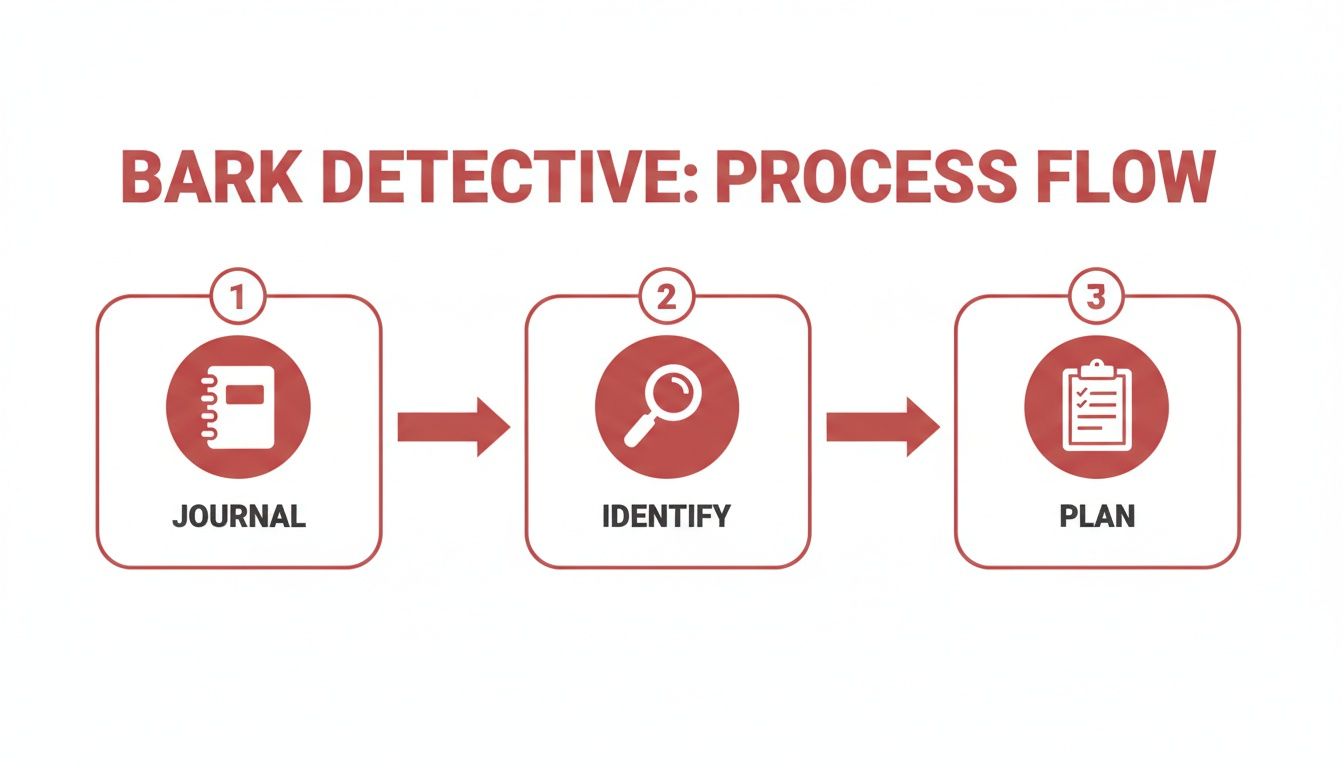
This simple flow is your roadmap. It helps you get ahead of the barking instead of just getting frustrated by it.
Teach an Alternative Behavior
Think about it: dogs bark to communicate a need. Whether it's "Pay attention to me!" or "That delivery driver is too close!" they're trying to get a result. So, instead of just shouting "No!" we need to give them a quieter, more polite way to "ask." A simple "sit" or "down" can become their new "please."
The key is to reward them for making a good choice on their own. See your dog chilling out on their bed instead of barking? Casually walk by and drop a high-value treat between their paws. No commands, no fanfare. You're simply marking the calm behavior you want to see more of. Over time, your dog makes the connection: "When I lie down quietly, good things happen."
This is a powerful way to head off demand barking, especially around mealtimes or when they want to play.
Introduce the "Quiet" Cue
Teaching a "Quiet" command is a total game-changer, but the process might feel a little backward at first. You're actually going to start by teaching your dog to bark on cue. Why? So you can then clearly mark and reward the moment they stop.
Here's how to do it:
- Find a reliable trigger. Figure out what gets your dog to bark consistently—a knock on the door, a specific doorbell sound on your phone, you name it.
- Put the bark on cue. Right before you trigger the bark, say "Speak!" in an upbeat voice. The moment they bark, praise them and give them a treat. Do this a few times until they start to connect the word with the action.
- Introduce "Quiet." Once they're barking reliably when you say "Speak!", let them bark once or twice. Then, hold a delicious, smelly treat right up to their nose and say "Quiet" in a calm voice. They'll stop barking to sniff the treat. That's your moment.
- Reward the silence. The second they go quiet, praise them ("Yes! Good quiet!") and give them the treat. Timing is everything here.
Start by rewarding just a second of silence. As they get the hang of it, you can gradually ask for 2, then 5, then 10 seconds of quiet before they get the reward. Keep your sessions short, fun, and always end on a high note.
Pro Tip: Keep training sessions to just 5-10 minutes. You want to build confidence, not burn them out. Master this in a quiet room before you even think about trying it in a real-world scenario.
Manage Triggers to Set Your Dog Up for Success
Training takes time. While you're working on new skills, management is your best friend. Every time your dog gets to practice their old barking habit, it just gets stronger. So, preventing the barking from happening in the first place is just as crucial as teaching them what to do instead.
Let's say you have a "window warrior" who barks at every leaf that blows by.
- Block the View: The easiest fix is to take away the trigger. Apply some translucent privacy film to the bottom half of your windows. It lets the light in but blocks the view of the street.
- Create Distance: If you can't block the view, use baby gates or rearrange furniture to keep your dog from getting right up against the glass.
Or what about the dog who demand-barks while you make their dinner? Try preparing their bowl while they're in the backyard or in another room. Better yet, turn meal prep into a game—toss pieces of their kibble on the kitchen floor for them to "find." They'll be too busy foraging to bark at you.
Change How They Feel About Triggers
For barking that comes from fear, anxiety, or pure over-the-top excitement, our job is bigger than just asking for quiet. We need to change how our dog feels about the trigger itself. This process is called counter-conditioning, and it works by pairing the "scary" thing with something undeniably awesome.
Real-World Example: The Doorbell Dilemma
- The Goal: We want your dog to think the doorbell predicts a treat party, not an invasion.
- The Setup: Grab a helper and a stash of super high-value treats (think tiny bits of chicken, cheese, or hot dogs).
- The Process: Have your partner stand outside. The instant they ring the doorbell, you toss a handful of treats all over the floor for your dog. Don't ask for a "sit" or anything else. The sound of the doorbell itself makes the treats magically appear.
- Repeat: Once your dog has hoovered up the goodies, signal your partner to ring it again. Boom—another treat explosion on the floor.
Keep these sessions super short, just a few reps at a time. Over time, your dog's reaction will start to shift from a panicked "BARK! INTRUDER!" to an excited "YES! Where are my snacks?!" This is one of the most powerful ways to stop barking because it fixes the problem at the emotional root.
Creating a Calmer Lifestyle for Your Dog

Training your dog not to bark doesn't happen in a vacuum. A dog who’s bored, under-exercised, or anxious is a dog who’s already primed to make a racket. I like to think of their lifestyle as the foundation of a house; if that base isn't solid, any training you try to build on top of it is going to be wobbly and unreliable.
By shaping your dog’s daily life to better meet their needs, you can dramatically lower their baseline stress and arousal. This makes them much less likely to fly off the handle at every little trigger. It's really about fostering a calmer state of being, which is where a quieter dog naturally emerges.
Fulfilling Physical and Mental Needs
You've probably heard the old saying, "a tired dog is a good dog." While there's truth to that, it's about so much more than just physical exhaustion. The real secret is a balanced routine that includes both a good run-around and some brain work. This is your best defense against the boredom and pent-up energy that fuel so much of that frustrating barking.
Your job is to give your dog constructive ways to be a dog. This proactive approach is always more effective than scrambling to stop a barking fit that’s already in full swing.
Here’s what a well-rounded enrichment plan can look like:
- Physical Exercise: This has to be more than a quick potty trip around the block. Aim for daily walks where your dog gets to sniff everything. That "sniffari" is incredibly stimulating for their brain. A good game of fetch or a romp at a dog park also works wonders for burning off that fizzy energy.
- Mental Enrichment: This is where you can have some real fun. Puzzle toys, snuffle mats, and food-dispensing toys are absolute game-changers. They turn mealtime into a problem-solving session that really works their mind.
- Jaw Exercise: Chewing is a dog's natural way of de-stressing. Giving them safe, appropriate chews offers a quiet, self-soothing activity, especially during those times you need them to settle down.
A Personal Tip: Ditch the food bowl. Seriously. I use my dog's daily kibble ration for training and enrichment throughout the day. A portion might go into a puzzle toy for breakfast, and I'll toss the rest for "find it" games around the house. This one small change adds a massive amount of mental stimulation to their day.
The Power of a Predictable Routine
Dogs are creatures of habit; they thrive on predictability. When your dog's day has a consistent rhythm, they know when it's time for action and when it's time to chill. That structure cuts down on the anxiety that comes from uncertainty—a major cause of nuisance barking.
When your dog knows that a morning walk is always followed by some quiet chew time in their crate, they’re far less likely to get antsy and start barking for attention. They learn to trust the flow of the day and settle down, confident that their needs will be met.
The Gut-Brain Connection and Your Dog's Mood
There's some fascinating science emerging about the powerful link between a dog's gut health and their brain. It's called the gut-brain axis, and the short version is this: an imbalanced gut can contribute to body-wide inflammation and stress. That stress often shows up as anxiety and reactivity, which can absolutely mean more barking.
This is where a more holistic view really makes a difference. Supporting your dog's internal health can have a profound impact on their outward behavior. A happy gut helps promote a more balanced mood, making your dog less prone to overreacting to the mail carrier or a squirrel. It's the perfect complement to all your training efforts.
This is where a high-quality daily supplement can play a fantastic supporting role. For instance, a superfood chew like FORMA is made to support wellness from the inside out. It's formulated with ingredients that promote calm while also supporting crucial gut health.
- For Calmness: It contains ingredients like L-theanine and chamomile, which are known to naturally encourage a sense of relaxation without making your dog drowsy.
- For Gut Health: A blend of probiotics and prebiotics helps maintain a healthy gut microbiome, which we now know is essential for regulating mood and stress.
This inside-out approach helps create a more resilient, less reactive dog, making all your hard work in training that much more effective.
The demand for quick fixes is massive—the global market for dog barking devices is projected to soar to $930 million by 2033. But a quiet shift is happening. Many millennial pet parents are looking for gentler, more complete solutions. A 2015 analysis found that 84% of nuisance barks happen when owners aren't home, highlighting an underlying anxiety that a simple device can't fix. You can dig deeper into these trends at Archive Market Research. By focusing on holistic wellness, you're not just putting a band-aid on the problem; you're addressing the root cause to build a foundation for lasting quiet.
Knowing When to Ask for Professional Help
Sometimes, even with the best intentions and a solid training plan, a barking problem can feel like too much to handle on your own. That’s perfectly okay. Recognizing when you need to bring in a professional is a sign of a great dog owner, not a failing one.
It can be tough to tell the difference between a normal training struggle and a sign of a deeper problem. If you’re feeling stuck or overwhelmed, resources like this guide on When To Hire A Trainer Or Go It Alone can help you decide on your next steps. Getting an expert opinion is simply a smart, proactive move for you and your dog.
Signs You Need a Professional Dog Trainer
A certified trainer brings a fresh, expert perspective to the table. They’re equipped to handle complex issues that go way beyond simple "I want a cookie" barking and can create a custom plan for more deep-rooted behaviors.
It’s probably time to call in a pro if you’re seeing any of these:
- Barking Paired with Aggression: This is the biggest red flag. If your dog’s barking comes with growling, snarling, lunging, or snapping at people or other animals, you need professional guidance immediately. Safety is non-negotiable.
- Obsessive or Compulsive Barking: Does your dog get "stuck" in a barking loop? If they bark endlessly at something and you can't distract them, it may have become a compulsive behavior that requires a more structured modification plan.
- Severe Fear or Anxiety: Barking that stems from intense fear or separation anxiety is a different beast. If being alone leads to destructive behavior, self-injury (like chewing paws raw), or non-stop frantic barking, a professional can help you address the underlying panic.
When you start your search, look for trainers with certifications like CPDT-KA (Certified Professional Dog Trainer - Knowledge Assessed). Make sure they are committed to positive reinforcement. Steer clear of anyone who suggests using punishment, prong collars, or shock collars to "correct" the behavior.
Crucial Takeaway: If your dog's barking ever makes you feel unsafe or is mixed with any kind of aggression, don't wait. Contact a qualified professional right away.
When to Call Your Veterinarian
Before you even dive into behavior modification, it’s critical to rule out a medical cause. A sudden change in your dog’s barking habits often has nothing to do with training—it can be their only way of telling you something hurts.
Your vet should be your first call if you notice any of these signs.
- A Sudden Start to Barking: If your normally quiet dog suddenly starts barking all the time, they could be trying to tell you they're in pain or feeling unwell.
- A Change in the Bark's Sound: A bark that suddenly sounds hoarse, weak, or pained is a clear signal that something physical might be wrong, like a sore throat or respiratory issue.
- Barking with Other Symptoms: Pay close attention if the new barking habit is coupled with things like lethargy, a lack of appetite, confusion, or pacing. This is particularly important for older dogs, as it could be a sign of Canine Cognitive Dysfunction (doggy dementia).
Tackling Your Top Questions About Barking
As you start this journey, you're bound to have questions. It’s completely normal! Getting a handle on what to expect can really help you stay the course and feel confident in your training plan. Here are some of the most common questions I hear from owners, with honest, straightforward answers.
Will My Dog Ever Stop Barking Completely?
In a word, no—and that's actually a good thing. Barking is a core part of how dogs communicate, and you wouldn't want to take that away entirely. Our goal isn't to create a silent dog, but to curb the excessive, nuisance barking.
Think of it this way: a bark to let you know a delivery person is at the door is useful. A 20-minute meltdown because a squirrel ran across the lawn is not. Successful training helps your dog learn the difference and gives them quieter ways to handle their big feelings.
The Real Goal: We're not aiming for total silence. The true win is transforming that frantic, non-stop noise into controlled, appropriate communication. You're teaching your dog a new way to express themselves, not demanding they stop talking altogether.
How Long Until I See a Change?
This is the classic "how long is a piece of string?" question. The truth is, the timeline for seeing real, lasting results varies wildly from dog to dog. It all comes down to a few key things:
- Your Dog's Background: A young puppy who's just discovered the power of demand barking will likely catch on much faster than an adult rescue who has spent years perfecting the art of fence-fighting.
- The "Why" Behind the Bark: Addressing barking born from boredom is often a quicker fix than untangling deep-seated separation anxiety.
- Your Consistency: This is the big one. Your commitment is the single most important factor. If you're consistent with managing the environment and rewarding quiet behavior, progress will come much faster than if training is hit-or-miss.
Most owners who stick with it notice small but significant improvements within a couple of weeks. Maybe the barking fits are shorter. Maybe your dog hesitates for a split second before sounding off. These are not small wins; they are huge signs that your dog is learning and your hard work is paying off.
Are Anti-Bark Collars Safe? Should I Use One?
This is a really debated topic, but for me, the answer is clear. I strongly recommend steering clear of tools like shock, citronella, or vibration collars. While they might seem like a quick fix, they work by punishing the dog with fear, surprise, or pain.
Here's the fundamental issue: these collars only suppress the symptom (the barking) without ever touching the root cause (the anxiety, excitement, or territorial feelings). This can easily backfire and create even bigger behavioral problems. A dog who is barking out of fear and then gets shocked might start to associate that painful jolt with whatever triggered the bark—like a child walking by—making them even more fearful and potentially aggressive.
Positive reinforcement training is not just the kinder approach; it’s far more effective for creating lasting change. It builds your dog's confidence and deepens your bond. Punishment-based methods do the opposite—they erode trust and can make anxiety worse.
Can My Dog's Diet Really Affect Their Barking?
Absolutely. We're learning more every day about the powerful connection between a dog's gut and their brain, often called the gut-brain axis. An unhealthy gut can lead to body-wide inflammation and stress, which frequently shows up as anxiety, reactivity, and you guessed it—excessive barking.
Diets heavy in processed ingredients can throw a dog's system out of whack. On the flip side, providing high-quality, nutrient-dense food creates a solid foundation for a calmer, more resilient dog. This is where a supportive supplement can make a real difference.
For instance, a daily chew like FORMA is specifically formulated to support both a calm mind and a healthy gut. It contains natural calming agents like chamomile and L-theanine to help soothe the nervous system. At the same time, its prebiotics and probiotics help foster a balanced gut microbiome, which is crucial for regulating mood and behavior. Think of it as supporting your training efforts from the inside out.

Karolis is the Founder of FORMA, a pet wellness brand focused on longevity and daily nutrition for dogs. Writes about supplements, canine health, and helping pets live longer, healthier lives
Join thousands of pet parents getting science-backed health insights and natural care advice