How to Read Dog Food Labels Without Getting Confused
Learn how to read dog food labels with this simple guide. We'll help you decode ingredients, understand AAFCO rules, and choose the best food for your dog.
Walking into the pet food aisle can be totally overwhelming. You’re hit with a wall of brightly colored bags, all screaming claims like "premium," "gourmet," and "natural." It’s easy to feel lost.
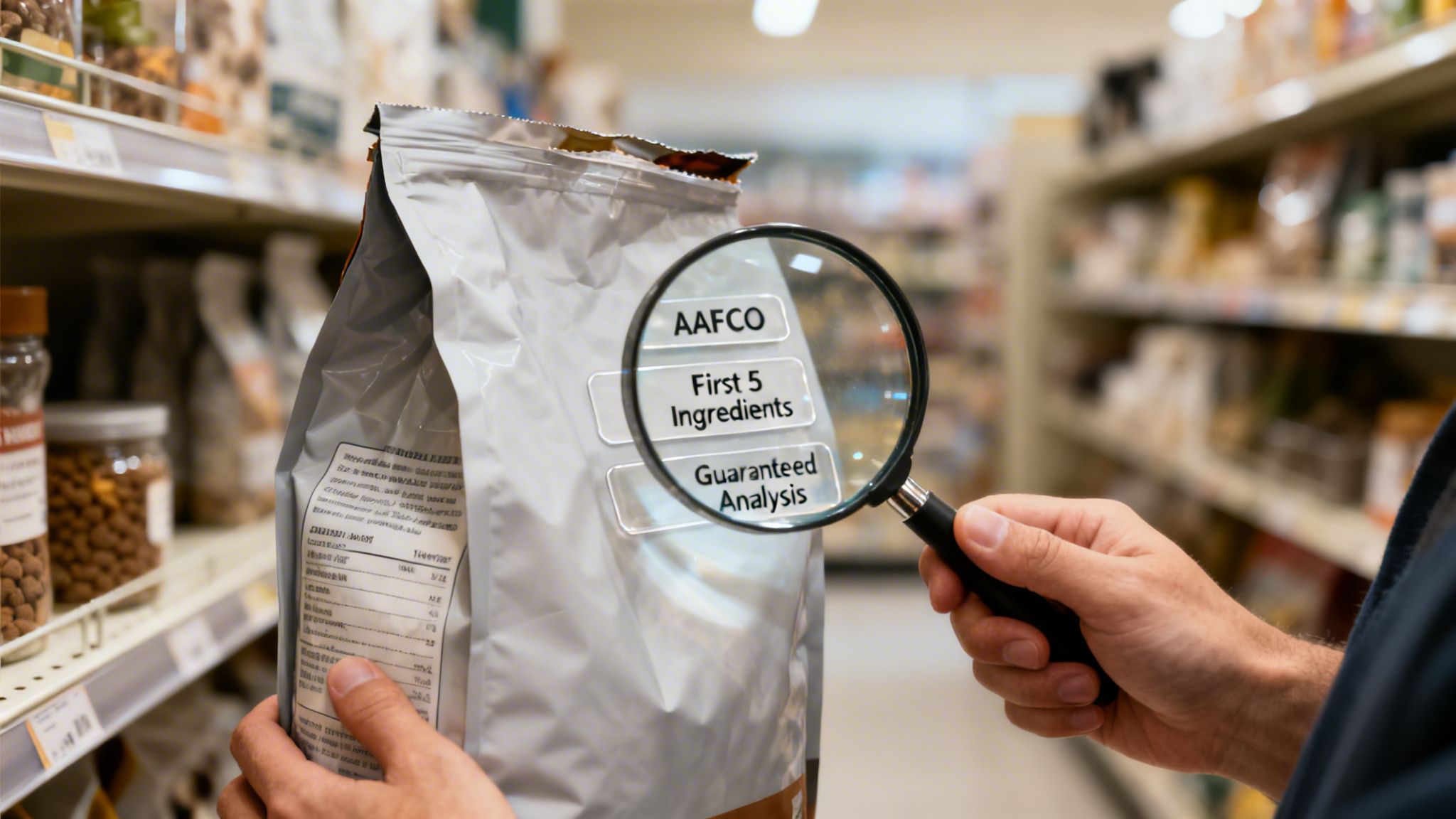
But here’s the secret: you only need to look for three key things to cut through all that noise. The real story of any dog food is found in the AAFCO nutritional adequacy statement, the first five ingredients, and the guaranteed analysis. These three elements tell you everything you truly need to know.
Your Quick Guide to Decoding Dog Food Labels
Let’s be honest, trying to choose the right dog food can feel like a high-stakes test you didn't study for. But it doesn't have to be that complicated. Once you know what to look for, you can walk down that aisle with confidence.
This guide will teach you how to read a dog food label like a pro. We'll break down each part, translating the confusing jargon into simple, practical information. Forget the flashy marketing on the front of the bag—we’re going straight to the facts that matter for your dog's health.
Moving Past the Marketing Hype
Pet food companies are brilliant marketers. They use attractive, feel-good words to grab your attention, but terms like "holistic" or "premium" often have no real regulatory meaning behind them. They can be slapped on a bag without meeting any specific quality standard.
Your job is to become a label detective. Learn to ignore the buzzwords and focus on what the food is actually made of. The fine print on the back of the bag is where the truth lies.
The most powerful tool you have in the pet food aisle isn't the price tag or the fancy bag design—it's knowing how to read and understand the information printed right on the label. That's where you find out what you're really feeding your dog.
To get started, let's look at how misleading some of these common marketing terms can be. The table below breaks down what these buzzwords actually mean (or don't mean) and helps you focus on what's truly important.
Marketing Buzzwords vs Label Reality
Once you learn to see past these claims, you can start focusing on the parts of the label that give you genuine insight into the food's quality.
The Ingredient List and What Really Matters
The front of a dog food bag is pure marketing. It’s designed to sell you a picture of a happy, healthy pup. The back of the bag, though? That’s where the facts are. The ingredient list tells the real story, and learning to decode it is the single most powerful skill you can have as a dog owner.
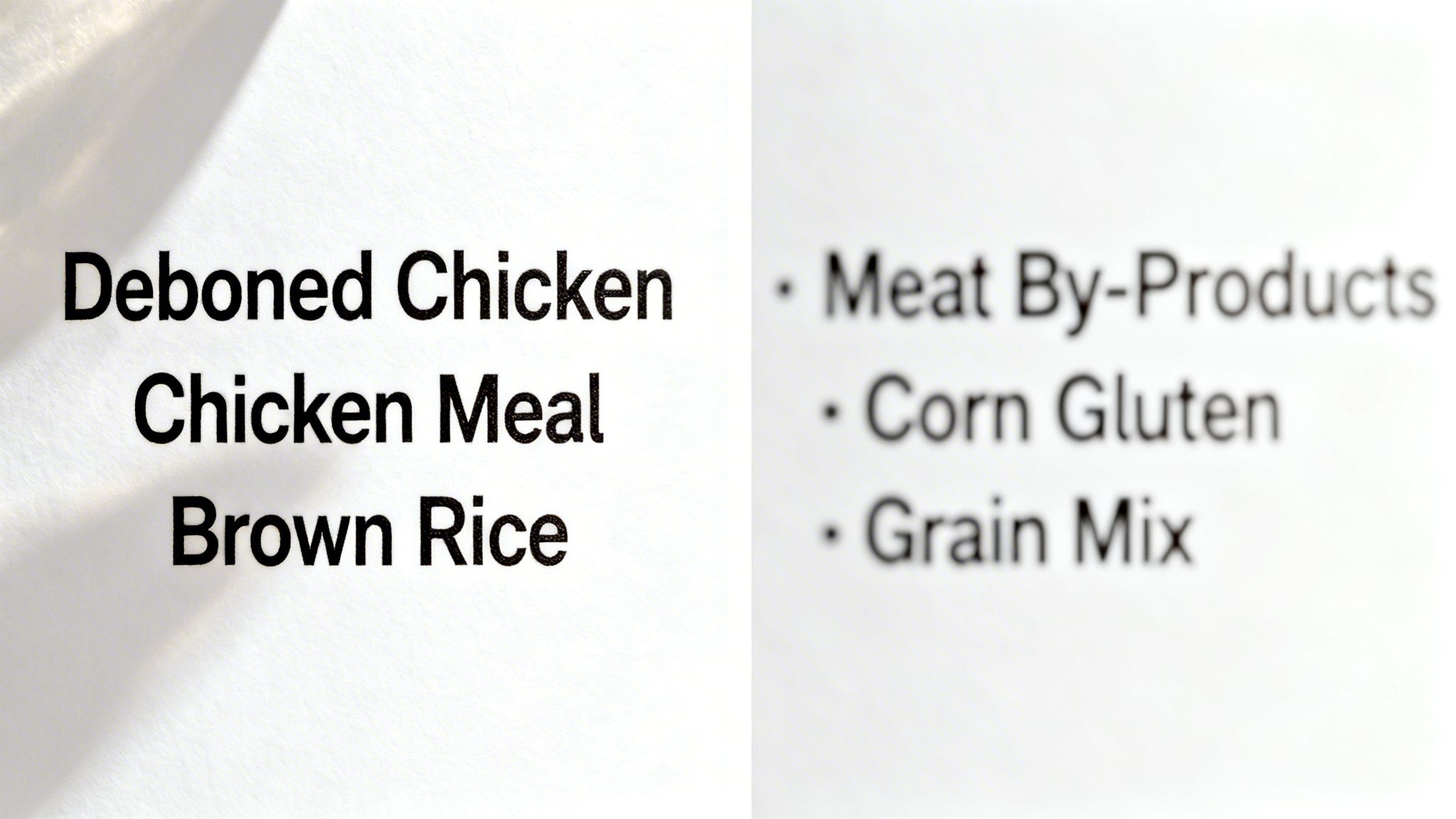
Ingredients are always listed by weight, with the heaviest items first. This means the first few ingredients are what make up the majority of your dog’s meal. Because of this, I always tell people to zoom in on the first five ingredients—they’re the nutritional foundation of the entire recipe.
The First Five Ingredients Rule
When you scan that list, you want to see high-quality, recognizable protein sources right at the top. This is non-negotiable for supporting strong muscles and good health.
Look for specific, whole-animal proteins. You want to see words like:
- "Deboned chicken"
- "Salmon"
- "Beef"
- "Lamb meal"
These terms are clear and transparent. A named "meal," like chicken meal, isn't a bad thing at all; it’s a concentrated protein source with the water rendered out, making it a very nutrient-dense ingredient.
On the other hand, vague terms should make you suspicious. If you see phrases like "meat and bone meal" or "poultry by-products," it’s a big red flag. These generic ingredients can come from a mishmash of sources and are almost always lower in quality.
Key Takeaway: A good dog food company will proudly and clearly list its protein sources. If the top ingredients sound like a mystery mix, it's probably best to put the bag down and find another option.
Spotting Ingredient Splitting
Here’s a clever trick manufacturers sometimes use to make a food seem more meat-heavy than it actually is: ingredient splitting. They’ll take a single, cheaper ingredient and list its different forms separately to push them down the list.
For example, let's say a food is loaded with peas. Instead of just listing "peas" as the #2 ingredient, a company might break it down like this:
- "Pea protein"
- "Pea fiber"
- "Peas"
Now, those three ingredients might show up at positions three, five, and seven. But if you were to combine them, peas would actually be the most plentiful ingredient in the bag, likely outweighing the meat. It’s a sneaky way to hide a recipe that relies on cheap plant-based fillers.
Identifying Quality Carbs and Fats
After the protein, you’ll find the carbohydrates and fats. Not all carbs are created equal. You want to see whole, nutrient-rich options like sweet potatoes, brown rice, or oatmeal. These are much better choices than corn, wheat, or soy, which are often just inexpensive fillers and can be common allergens for some dogs.
The fat source is just as important. Look for named sources like "chicken fat" or "salmon oil." These are far superior to a vague term like "animal fat," which could come from anywhere. Good fats are critical for a healthy coat, sharp brain function, and sustained energy.
Red Flags to Avoid on the Label
Beyond the main ingredients, certain additives should make you think twice. Knowing what to avoid is just as important as knowing what to look for. Keep an eye out for these red flags anywhere in the list.
Artificial Preservatives: Chemicals like BHA, BHT, and ethoxyquin are used to give food a longer shelf life, but they’re controversial. I much prefer to see natural preservatives like mixed tocopherols, which is just a source of Vitamin E.
Artificial Colors and Flavors: Your dog couldn't care less if its kibble is bright red. Dyes like Red 40, Yellow 5, and Blue 2 are only there to appeal to the person buying the food. The term "natural flavors" is also a bit of a smoke screen—it's a vague phrase that can hide a ton of different additives.
Sweeteners: Ingredients like corn syrup or sucrose are sometimes added to make a bland food taste better. Your dog absolutely does not need added sugar, which can lead to weight gain and other health problems down the road.
By focusing on those first five ingredients, watching for tricks like splitting, and knowing which additives to steer clear of, you can walk into any pet store and confidently choose a food that will truly nourish your dog.
What's in a Name? Cracking the AAFCO Naming Code
The name on the front of a dog food bag tells a much bigger story than you might realize. It’s not just clever marketing; it’s a regulated system designed by the Association of American Feed Control Officials (AAFCO). These naming rules are surprisingly powerful, giving you a sneak peek into the recipe before you even turn the bag over.
Learning this code is a game-changer. It’s the difference between buying a bag that’s genuinely packed with beef versus one that just has a whisper of beef flavor. Once you understand the percentages, you can instantly see past the enticing pictures and choose a food based on substance, not just style.
The 95% Rule: The Gold Standard
When you see a dog food named something simple like “Beef for Dogs” or “Chicken Dog Food,” you’ve hit the jackpot. This is the 95% Rule, the highest standard in AAFCO's naming conventions.
It means that the named ingredient—in this case, beef or chicken—must make up at least 95% of the total product weight, not counting any water added for processing. This rule is straightforward and powerful, leaving very little room for cheap fillers to dominate the recipe. If you're looking for a food where the primary ingredient is clearly and overwhelmingly a single protein source, this is what you want to see.
The 25% Rule: The "Dinner" and "Entrée" Clue
This is where things get a bit more complex. If a product name includes a descriptor like “Dinner,” “Platter,” “Entrée,” or “Formula”—think “Chicken Dinner for Dogs”—the 25% Rule kicks in. This means the named ingredient (chicken) must make up at least 25% of the product, but less than 95%.
That's a huge drop from the 95% rule. A "Beef Dinner" can have far less beef than a product simply called "Beef for Dogs." These foods often rely more heavily on other ingredients like grains, vegetables, and different protein sources to fill out the recipe. This isn’t automatically bad, but it’s crucial to know that “dinner” signals a much lower meat inclusion.
Pro Tip: Watch out for combination names like “Beef and Lamb Entrée.” Both ingredients together must total 25% of the food. However, the second ingredient listed (lamb) only needs to make up a minimum of 3%, so the beef could be doing almost all the heavy lifting.
The 3% "With" Rule: A Hint of an Ingredient
Have you ever spotted a bag that says something like “Dog Food with Real Chicken”? That tiny word, "with," is incredibly important. It triggers the 3% Rule, which only requires the named ingredient to make up a minimum of 3% of the total product.
This rule lets manufacturers highlight a popular ingredient on the front of the package, even if it's only there in a very small amount. That "Dog Food with Real Chicken" is likely made mostly of other proteins, with just a touch of chicken added for marketing appeal. It’s a common tactic that can easily mislead you if you don't know the rule.
The "Flavor" Rule: The Tiniest Trace
Finally, we have the most elusive rule of all: the Flavor Rule. If you see a product named “Chicken Flavor Dog Food,” it means there only needs to be enough of that ingredient to be detectable by taste. There is no minimum percentage required; it could be as low as 1-3%.
Often, the flavor comes from a "digest"—a broth made from animal tissues—rather than actual whole meat. This is the ultimate example of marketing over substance. You’re promised a flavor your dog might enjoy, but you’re not getting much, if any, of the actual core ingredient.
Understanding these naming conventions is like having a secret decoder ring for the pet food aisle. In fact, a 2023 market study found that 68% of millennial dog owners in the US switched brands after learning these rules, showing a clear preference for transparency. You can dig deeper into these labeling standards by checking out what AAFCO says about reading labels. By applying this knowledge, you can confidently tell the difference between a meat-rich meal and a cleverly marketed bag of fillers.
Making Sense of the Guaranteed Analysis
Every dog food bag has a "Guaranteed Analysis" panel. Think of it as the nutrition facts label for your pup. It lists the minimum percentages of crude protein and fat, along with the maximum percentages for fiber and moisture.
On the surface, it seems simple enough. But these numbers can be misleading, and comparing them directly between different foods is one of the biggest mistakes pet parents make. This is especially true when you're trying to compare a can of wet food to a bag of dry kibble.
The "As-Fed" Numbers Can Trick You
The percentages on the label are listed on an "as-fed" basis, which means they include all the water in the food. This is where things get tricky.
Dry kibble might have around 10% moisture, but a can of wet food can be 78% water or even more. That massive difference in water content dilutes the nutrient percentages in the wet food, making it look much less nutritious than it really is.
For example, you might see a wet food with 8% crude protein next to a dry food boasting 30%. You'd think the kibble is the obvious winner, right? Not so fast. To get a real, honest comparison, you have to take the water out of the equation. This is where a little bit of math called calculating the dry matter basis comes in.
How to Calculate Dry Matter Basis
Calculating the dry matter basis (DMB) is the only way to accurately compare the protein, fat, or fiber in different foods. It sounds complicated, but I promise the math is simple. It just reveals what’s actually in the food once the water is gone.
Here’s how you do it:
- Find the moisture percentage on the Guaranteed Analysis panel.
- Subtract that number from 100. This gives you the total dry matter percentage.
- Divide the nutrient percentage (like protein) by the dry matter percentage, then multiply by 100.
Let's walk through a real-world example. Say you're deciding between a wet food and a dry kibble:
- Wet Food: 8% Protein, 78% Moisture
- Dry Kibble: 30% Protein, 10% Moisture
At first glance, the kibble seems way higher in protein. But watch what happens when we convert to a dry matter basis.
For the Wet Food: First, find the dry matter: 100% - 78% moisture = 22% dry matter.
Now, calculate the true protein: (8% protein / 22% dry matter) x 100 = 36.4% protein on a DMB.For the Dry Kibble: First, find the dry matter: 100% - 10% moisture = 90% dry matter.
Now, calculate the true protein: (30% protein / 90% dry matter) x 100 = 33.3% protein on a DMB.
Suddenly, the wet food actually has more protein than the kibble. This simple trick helps you see past the label's numbers and understand what you're really feeding your dog.
As-Fed vs Dry Matter Basis: A Real-World Comparison
This table shows just how different the numbers look once you account for moisture. Notice how the wet food's protein and fat levels jump dramatically on a dry matter basis, revealing a much richer nutrient profile than the "as-fed" numbers suggest.
This is why you can't just glance at the percentages on the front of the bag. Learning to do this quick calculation is a game-changer for making informed decisions.
Why This Matters for Your Dog's Health
It's easy to dismiss this as just numbers, but getting it wrong has real consequences. A 2022 PetMD survey revealed that 55% of dog owners in the US don't pay close attention to the Guaranteed Analysis. This oversight is a contributing factor to the rise in pet obesity.
Experts warn that overfeeding your dog by just 20% can shorten their life by nearly two years. Knowing how to properly assess their food is a critical first step. If you want to dive deeper, you can explore detailed insights on pet food labels to become even more confident in your choices.
The image below gives you a cheat sheet for another part of the label—the product name. The rules set by AAFCO show how a single word can change the entire meaning of a food's recipe.
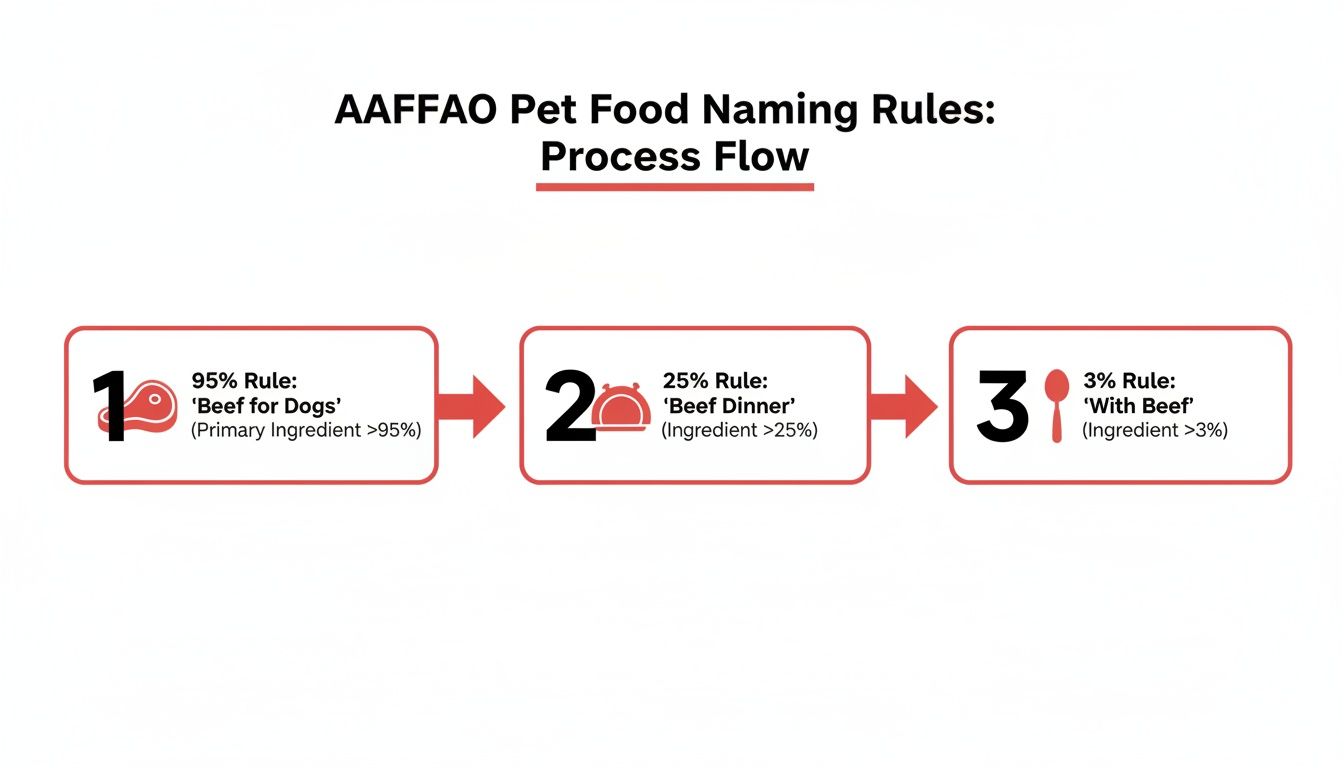
As you can see, a food called "Beef for Dogs" (the 95% rule) is worlds apart from "Beef Dinner" (the 25% rule) or "Dog Food with Beef" (the 3% rule).
Finding the Right Protein and Fat Levels
Okay, so now you know how to find the true nutrient levels. But what numbers should you aim for? It really depends on your dog's specific needs—their age, breed, and how active they are.
Here are some general guidelines (on a dry matter basis):
- Puppies: Need more fuel for growth. Look for higher protein (22-32% DMB) and fat.
- Adult Dogs: Most healthy adults do well with moderate protein (18-28% DMB) for maintenance.
- Active or Working Dogs: These athletes need more protein and fat to power their muscles and recover.
- Senior Dogs: Often benefit from high-quality, easily digestible protein to help maintain muscle, even if their overall calorie needs are lower.
Your vet is always your best resource for figuring out the perfect nutritional profile for your dog. But by mastering the Guaranteed Analysis and a little dry matter math, you're no longer relying on marketing—you're making choices based on facts.
Putting It All Together for Your Dog
Alright, you've done the hard work of learning how to decode a dog food label and see past all the flashy marketing. Now comes the most important part: using that knowledge to pick the right food for your dog.
Choosing a good food is a huge win, but making sure it actually works for your individual pup is what truly counts. This means looking beyond the bag and paying close attention to your dog.
The "Feeding Guidelines" chart on the bag? Think of it as a starting point, not gospel. Those numbers are based on an "average" dog, but let's be real—your dog is one of a kind. Is she a professional couch-warmer or a future agility star? Her breed, age, and whether she's spayed or neutered all play a massive role in how many calories she actually needs.
My advice is to always start on the lower end of the recommended amount and watch your dog's body condition. You want to be able to feel their ribs easily, but not see them sticking out.
The Last Check: Nutritional Adequacy
Before you walk out of the store with that new bag, there's one final, crucial thing to check: the AAFCO Nutritional Adequacy Statement. This little block of text is your guarantee that you’re not just buying filler. It confirms the food is "complete and balanced" and tells you exactly which type of dog it’s meant for.
You’ll see a few common phrases:
- For maintenance: This is your standard adult dog formula.
- For growth: Made specifically for puppies, who need more protein, fat, and calories to grow.
- For all life stages: This means it meets the higher nutritional demands of puppies, so it's usually fine for active adults, too. Just be careful, as it might be too rich for a senior or a less active dog.
This statement is your safety net. It proves the food provides everything your dog needs to thrive based on established scientific standards. Getting this right is especially vital when finding the best dog food for puppies, since their dietary needs are so specific.
How to Switch Foods Without Upsetting Their Tummy
Ever switched your dog’s food too quickly and dealt with the messy aftermath? It’s a common mistake. A sudden change can wreak havoc on their digestive system, so a slow, gradual transition is the only way to go. This gives their gut bacteria time to adjust to the new ingredients.
Here’s a simple 7-day plan that has always worked for me:
- Days 1-2: Mix 75% old food with 25% new food.
- Days 3-4: Go 50/50 with the old and new food.
- Days 5-6: Tip the scales to 25% old food and 75% new food.
- Day 7: You’re on 100% new food!
Keep a close eye on your dog’s poop during the switch. If things look a little soft or upset, just slow it down. Spend an extra day or two on the current ratio before moving on.
Your Dog Is the Ultimate Report Card
Once you’ve fully switched to the new food, your job is to simply watch your dog. Their body will tell you everything you need to know about whether you made the right choice. Over the next few weeks, you should see either positive changes or signs that this food isn't the one.
A high-quality diet does more than just fill a bowl—it fuels their entire well-being. The best proof you’ve found a great food is seeing it in your dog’s shiny coat, bright eyes, and happy energy.
Here are the signs I look for to confirm a food is a winner:
- Great Skin and Coat: A soft, glossy coat without any dandruff or excessive shedding.
- Steady Energy: Consistent energy levels—not wild, frantic bursts followed by crashes.
- Happy Digestion: Firm, consistent, and predictable poops. No surprises!
- Healthy Weight: They maintain their ideal weight without you having to constantly adjust their portions.
By combining your new label-reading skills with careful observation, you can confidently find a food that sets your dog up for a long, vibrant, and happy life.
Common Questions About Dog Food Labels
Once you start decoding dog food labels, you'll find a few common questions pop up again and again. Let's tackle some of the trickiest parts so you can feel totally confident in the dog food aisle.
What Is the Difference Between Meal and By-Products?
It's easy to see "chicken meal" and "chicken by-products" on a label and think they're similar, but in terms of quality, they are worlds apart.
A named meat meal, like "chicken meal" or "lamb meal," is actually a really high-quality, concentrated source of protein. The process is pretty simple: they take the meat, cook it down to remove the water and fat, and what's left is a nutrient-packed powder. Because the water is gone, meat meal actually contains more protein by weight than whole meat.
By-products, however, are a different story. This term refers to what’s left of an animal after the main cuts of meat have been taken for human consumption. Now, this could include nutritious organs like the liver or lungs. But it could also include much less desirable parts like bones or intestines. The term is deliberately vague, which makes it impossible to know exactly what you're getting.
My personal rule of thumb is to stick with foods that list whole, named meats or specific meat meals right at the top. Vague terms like "by-products" are a major red flag for me, signaling potentially lower-quality stuff.
Is Grain-Free Dog Food Always Healthier?
Not really. The whole "grain-free" thing exploded in popularity, but it's often more about marketing than a clear-cut sign of a superior food. Many grain-free formulas just swap out corn and wheat for other starchy ingredients like potatoes, peas, or lentils. These can still be loaded with carbohydrates and essentially act as cheap fillers.
On top of that, the FDA has been investigating a potential link between certain grain-free diets and a serious heart condition in dogs called dilated cardiomyopathy (DCM). The diets of concern are often those that are high in legumes.
So, instead of just looking for the "grain-free" label, it's way more helpful to look at the overall ingredient quality. A food made with high-quality whole grains like brown rice or oatmeal is often a much better pick than a grain-free option filled with pea protein. As always, your vet is the best person to help you decide what’s right for your dog.
How Important Is the Best By Date?
That "best by" date is incredibly important—you should never ignore it. It’s the manufacturer's promise that the food will stay fresh and hold its nutritional value up until that day.
Once that date passes, a couple of things start to go wrong:
- The fats in the kibble can go rancid, which can lead to an upset stomach or other health problems.
- Key vitamins and nutrients, especially the fat-soluble ones, start to break down and become less effective.
Make a habit of checking the date before you even put a bag in your cart. And once you get it home, store the food in a cool, dry place. The best way to keep it fresh is to leave it in its original bag and place the whole thing inside an airtight container.
Does a Higher Price Mean Better Quality Dog Food?
A higher price can point to better quality, but it's definitely not a guarantee. You'll find some of the most expensive brands pour a ton of money into slick marketing and beautiful packaging rather than sourcing top-tier ingredients.
On the flip side, some truly excellent, high-quality foods are out there at more moderate prices. The best approach is to ignore the price tag at first. Put your new label-reading skills to work: analyze the ingredient list, find that AAFCO statement, and check the guaranteed analysis.
Once you’ve actually judged the food based on what’s inside the bag, then look at the price. You’ll probably find that the best value isn’t the fanciest bag on the shelf, but the one that delivers solid nutrition for a reasonable cost.

Karolis is the Founder of FORMA, a pet wellness brand focused on longevity and daily nutrition for dogs. Writes about supplements, canine health, and helping pets live longer, healthier lives
Join thousands of pet parents getting science-backed health insights and natural care advice